

A packet that changes shape after bonding has experienced a thermal cycle, adhesive reaction, mechanical restraint and unloading. Measuring it only after cooling merges those events. The engineer sees the final strain but cannot yet identify which stage produced it.
Adhesive reaction can change volume and stiffness. Cooling can produce differential contraction between materials. The fixture decides when and where those changes are restrained. A practical experiment follows the developing strain rather than trying to assign the entire final movement to cure shrinkage.
Identify when the adhesive starts transferring load
Before the adhesive develops meaningful stiffness, local contraction may be accommodated by flow or movement. After a connected load path develops, the same contraction can produce restraint forces. The relevant transition must come from the material system and process evidence. It cannot be assumed to occur at the moment an oven reaches its set temperature.
Measure temperatures at representative packet and tool locations. An oven trace is a boundary condition, not proof of a uniform specimen temperature. Record fixture load or displacement where possible, because thermal expansion of the tool can change restraint during the trial.
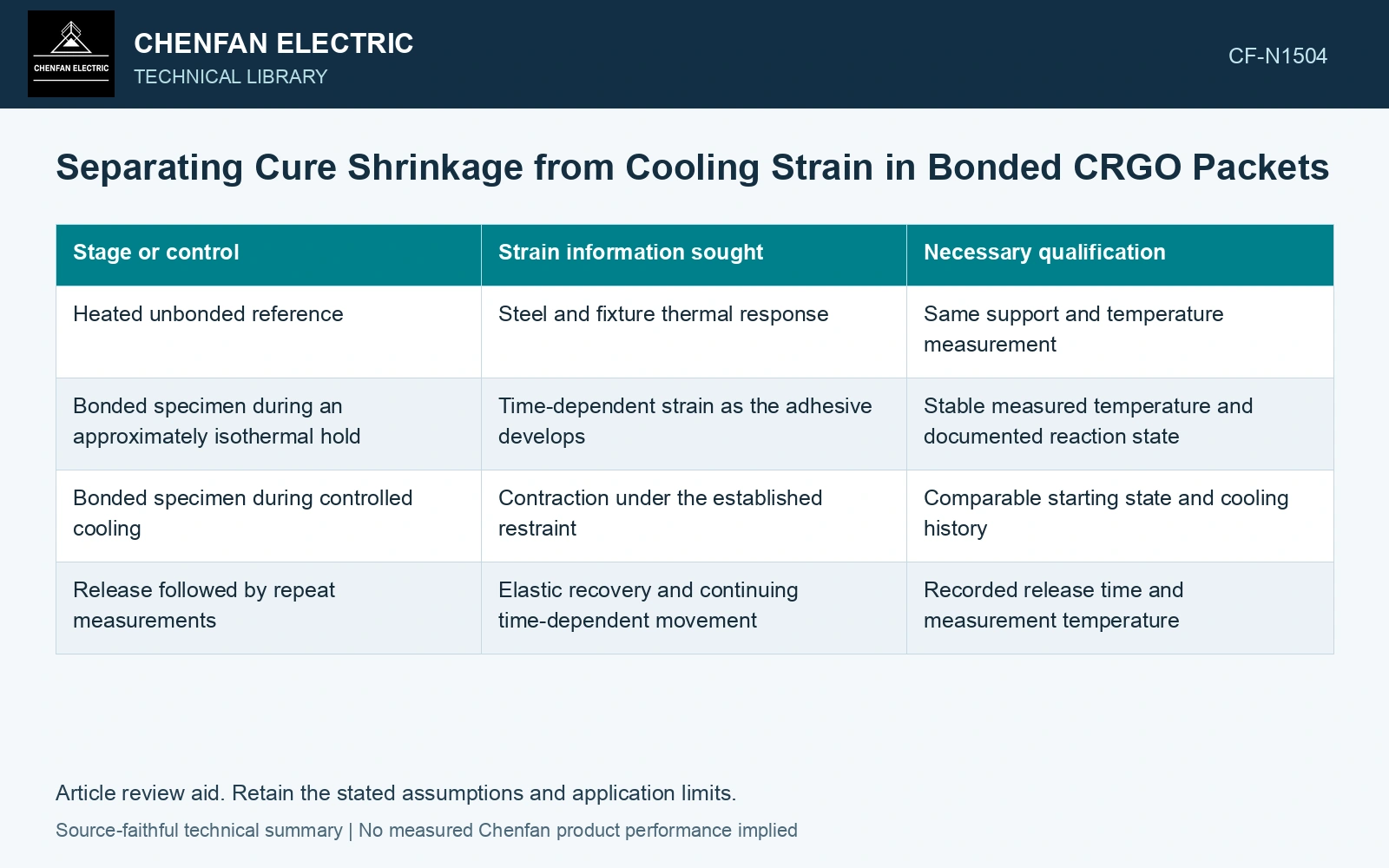
| Stage or control | Strain information sought | Necessary qualification |
|---|---|---|
| Heated unbonded reference | Steel and fixture thermal response | Same support and temperature measurement |
| Bonded specimen during an approximately isothermal hold | Time-dependent strain as the adhesive develops | Stable measured temperature and documented reaction state |
| Bonded specimen during controlled cooling | Contraction under the established restraint | Comparable starting state and cooling history |
| Release followed by repeat measurements | Elastic recovery and continuing time-dependent movement | Recorded release time and measurement temperature |
The controls do not produce a perfect chemical-versus-thermal split automatically. Temperature changes can affect reaction rate, while reaction changes stiffness. Their purpose is to make those interactions visible and constrain the interpretation.
Compare histories rather than subtracting two endpoints
Plot measured strain against both time and specimen temperature. Mark loading changes, the selected reaction-state indicators and fixture release. If strain continues at stable temperature, investigate reaction, viscoelastic response and measurement drift. If strain changes primarily during cooling, compare the thermal response with the reference and the restraint history.
Use an instrument reference or stable check to distinguish specimen movement from drift. Place measurement points so that overall bending and local extension can be separated. A single surface gauge can include bending strain that does not represent the packet’s average length change.
Connect the residual state to magnetic evaluation
Compare magnetic measurements at the same temperature, excitation, material orientation and mechanical condition. A measurement taken while one packet remains clamped and another is free does not isolate the bonding history. Track unloaded shape and any remaining restraint before interpreting the magnetic difference.
The experiment should answer a narrow process question: which portion of the cycle introduces the residual condition that persists into the intended assembly? It may show that cooling restraint dominates a particular configuration, or that movement begins during a hold. Either finding needs its actual trace and controls. A final room-temperature dimension is useful for fit; its history is needed to decide which process stage to change.
Technical references
- voestalpine. Backlack: Lamination bonding.
- voestalpine. Backlack: Testing methods and production of test specimens.