

FLISR load-transfer checks must establish that an unfaulted section can be supplied through the proposed path without exceeding the receiving equipment’s permitted duty. Fault location, isolation and service restoration are connected decisions. A route that is electrically connected is not necessarily a permissible restoration route. Transformer loading, phase currents, voltage, protection and the credibility of switch information must all remain part of the decision.
Validate the candidate state
Tie-switch placement establishes possible alternate routes. Before an automated transfer is released, the control scheme also needs confirmed isolation boundaries, source availability and the intended open points. Unknown or contradictory switch indications should be handled by the approved blocking or operator-review logic, rather than assumed to represent a healthy radial path.
SEL’s transfer-scheme paper documents the importance of fault blocking, communication supervision, available closing power and commissioning checks. These are lessons from actual transfer applications, not a promise that every FLISR implementation restores all loads or operates within the same time. [1]
Screen complex power, then review the full duty
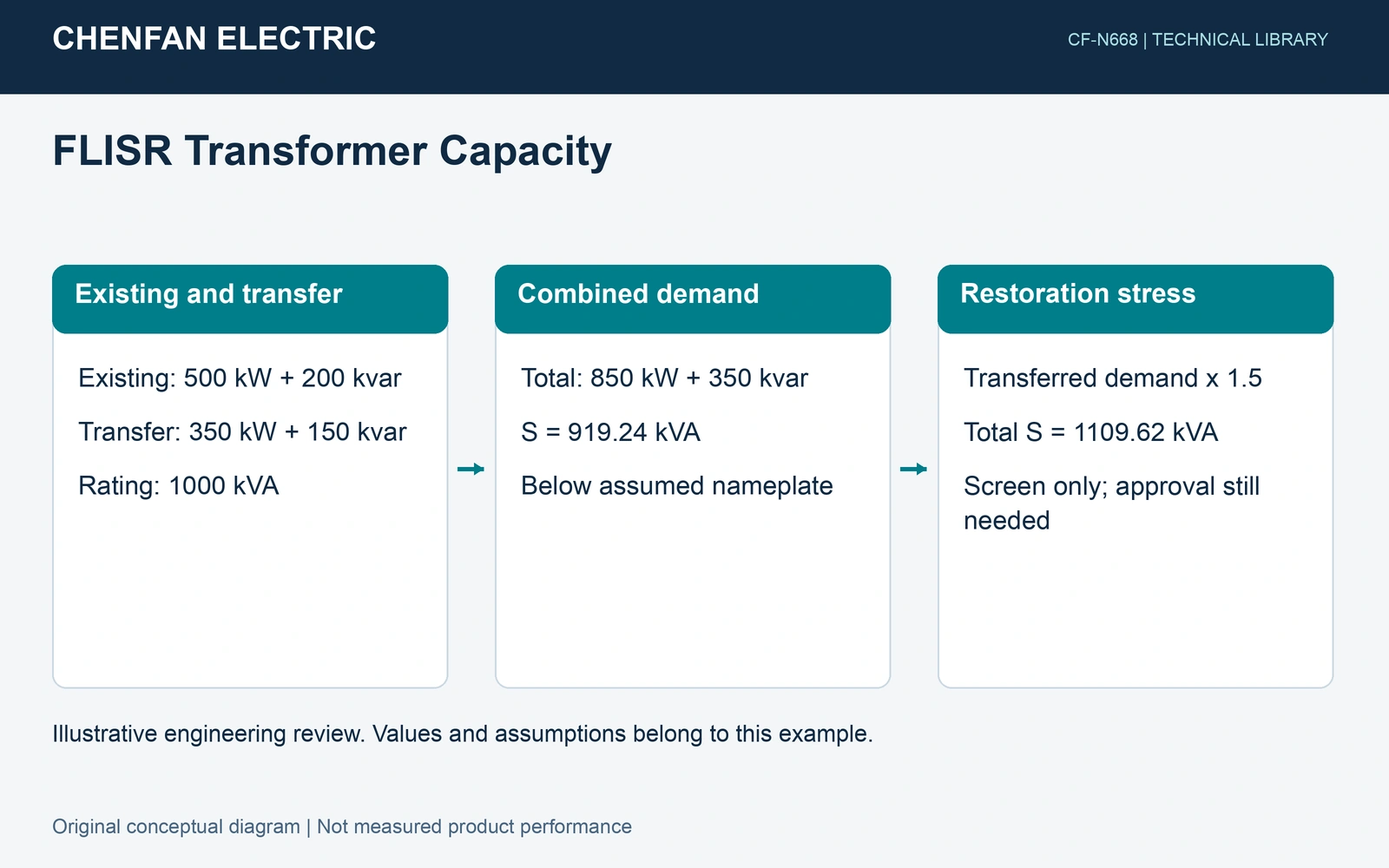
For a balanced sinusoidal illustration, assume a receiving transformer rated 1,000 kVA already supplies 500 kW and 200 kvar. The proposed transferred section contributes 350 kW and 150 kvar at the same boundary and instant. Add active and reactive power separately: S = √[(500 + 350)² + (200 + 150)²] = 919.24 kVA. Adding the magnitudes of the two separate apparent powers would not describe their combined P-Q state.
Now assume, solely for comparison, that restoration temporarily multiplies both transferred P and Q by 1.5. Existing demand remains unchanged. The combined duty becomes 1,025 kW and 425 kvar, or 1,109.62 kVA. This assumed multiplier is not a universal cold-load pickup allowance; its purpose is to show how a normal-demand transfer can lose its apparent headroom.
| Case | Combined P / Q | Apparent power | Meaning |
|---|---|---|---|
| Normal transferred demand | 850 kW / 350 kvar | 919.24 kVA | Below the assumed nameplate |
| Transferred P and Q × 1.5 | 1,025 kW / 425 kvar | 1,109.62 kVA | Above the assumed nameplate |
Keep capacity and execution permission separate
The example is an independent arithmetic derivation, not a power-flow solution or thermal permission. Real candidates need phase and neutral currents, downstream voltages, feeder and switch ratings, DER states and the transformer’s initial temperatures and available cooling. A nameplate comparison alone neither authorizes temporary overload nor demonstrates that distant loads receive acceptable voltage.
Adaptive protection may be needed when the transfer changes source direction, minimum fault current or protection zones. The authorized sequence must define how valid protection is established and confirmed. Communication loss, stale measurements or an unsuccessful switch operation require an engineered response; a successful connectivity calculation cannot substitute for those conditions.
Procurement inputs and acceptance
Request transformer ratings by cooling state, impedance and connection data, agreed thermal limits, measurements with timestamps, the transfer-load chronology and the protection-state matrix. The network designer owns restoration authorization. Equipment suppliers provide the specified data and interfaces within their scope. Acceptance should test failure cases and retain event records, rather than demonstrate only a healthy-path transfer.