


Transformer Core Engineering Notes · CF-N295
Transformer liquid volume is not merely a purchasing quantity. It links tank geometry, cooling circuits, expansion, transport mass and site containment. A credible liquid schedule should identify the actual compartments and reference conditions, while leaving thermal performance and fire planning to their respective complete-system assessments.
Reconcile the physical inventory
Include the main tank and relevant radiators, conservator, piping and separate compartments. Clarify which values are measured, calculated or preliminary and at what reference temperature. Distinguish liquid volume from liquid mass using the product-specific density basis. A final schedule should reconcile with the approved drawings and filling records, not simply repeat a rounded estimate carried forward from the tender stage.
Do not equate volume with cooling capability
Liquid contributes to heat storage and transport, but useful cooling also depends on circulation, ducts and heat-rejection surfaces. A larger inventory does not automatically provide a higher continuous rating. The OEM’s thermal assessment should describe the relevant flow paths and operating state. Conversely, reducing volume for compactness can change thermal response and expansion assumptions and should not be accepted as a neutral packaging change.
Coordinate expansion and delivery states
The preservation system must accommodate the approved liquid and temperature range. Shipping partially filled, dry or in another defined condition creates a different mass and handling state from service. Record those states separately with the OEM’s approved instructions. A logistics decision to change liquid quantity should not be made independently of tank, preservation and commissioning requirements.
Pass final data to site designers
Civil and fire designers need the appropriate inventory and release interfaces for their site assessment. A change of liquid type can affect compatibility and the applicable design basis, but it does not create an automatic exemption from local requirements. Maintain a revision-controlled schedule shared with the responsible parties. The useful final deliverable is a reconciled liquid system, not one isolated volume number on a sales sheet.
| Review item | Evidence to request | Boundary to preserve |
|---|---|---|
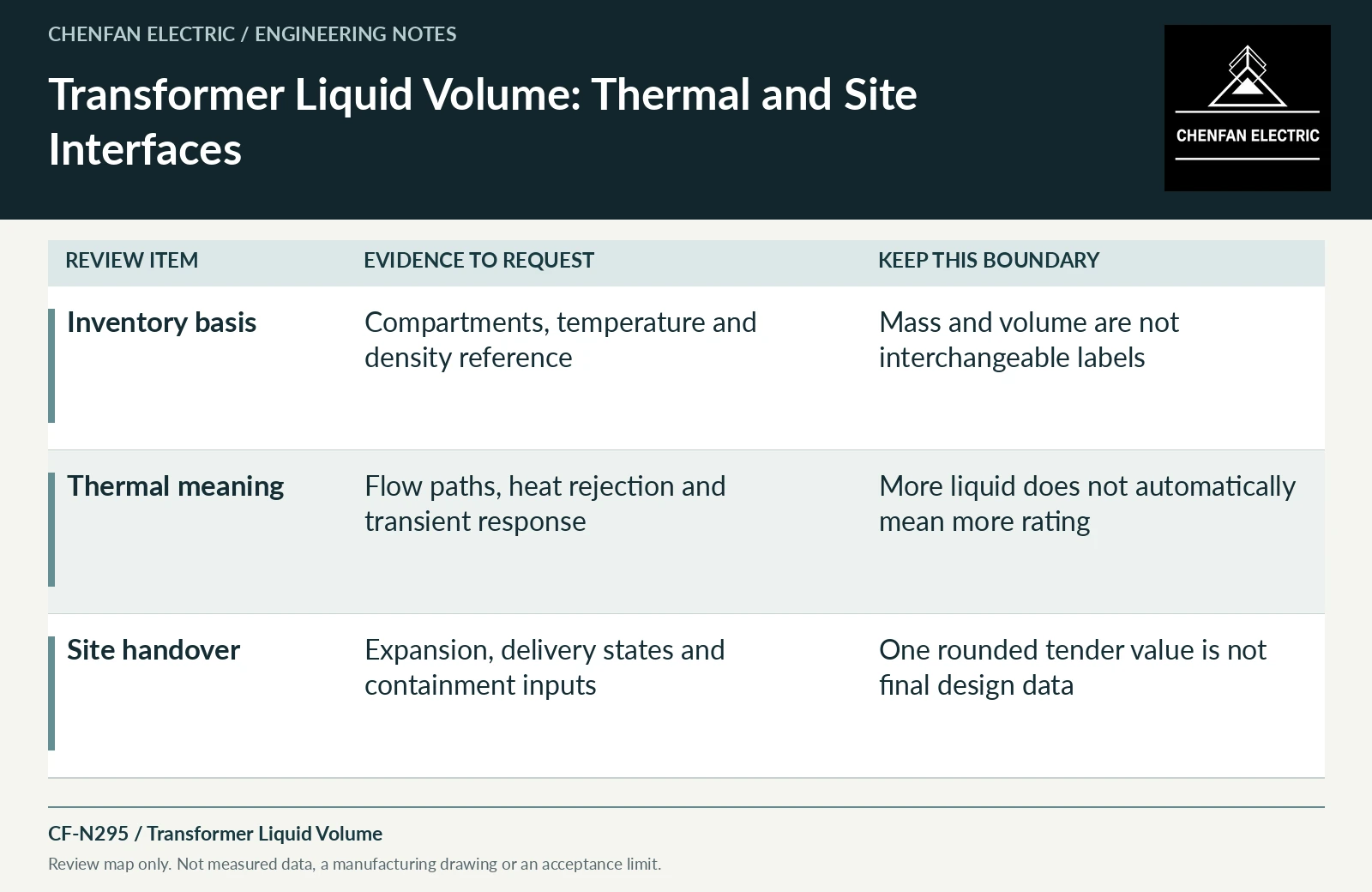
| Inventory basis | Compartments, temperature and density reference | Mass and volume are not interchangeable labels |
| Thermal meaning | Flow paths, heat rejection and transient response | More liquid does not automatically mean more rating |
| Site handover | Expansion, delivery states and containment inputs | One rounded tender value is not final design data |
References and scope
- IEC 60076-1:2011 — Power transformers: GeneralPublic standard abstract · General transformer scope, interfaces and controlled equipment specification.
- IEC 60076-2:2011 — Temperature rise for liquid-immersed transformersPublic standard abstract · Temperature-rise requirements, cooling identification and the distinction between test conditions and installed duty.
- IEEE C57.166-2026 — Acceptance and Maintenance of Insulating Liquids in Transformers and Related EquipmentPublic standard abstract · Acceptance and maintenance of insulating liquids; equipment type, liquid family and compartment must be identified.
- Transformer Fire Protection (FIST 3-32), redacted releaseHistorical technical manual · Fire protection and installation interfaces; local authority and project requirements remain separate.