


Transformer Core Engineering Notes · CF-N273
A transformer breather serves a defined air-exchange path in the liquid-preservation system. Its condition can provide useful maintenance information, but it is not a direct measurement of moisture throughout the paper insulation. Specify the breather arrangement, operating environment and inspection responsibilities without treating a visible desiccant indicator as a complete transformer condition assessment.
Confirm which space breathes through the device
Identify the conservator or other compartment connected to the breather and review the intervening pipework. Separate breathing circuits may serve different liquid systems. A clean-looking device is not useful if the intended air path bypasses it or is incorrectly connected. The OEM drawing should identify the circuit, relevant valves and interfaces so the owner knows what the device actually protects.
Match the design to service conditions
Breathing duty depends on the equipment arrangement and temperature-driven volume changes. Ambient humidity, dust, temperature and access can affect the maintenance burden. Regenerating devices introduce their own power, controls and failure indications. Compare the offered arrangement against the site’s available support rather than assuming an automatic device has no service requirements or that all passive devices have the same interval.
Interpret desiccant indication carefully
Use the specific manufacturer’s indication scheme and service criteria. Different products need not use the same color convention. The visible state of the desiccant describes that material and its exposure; it does not quantify paper moisture or exclude a leak elsewhere in the preservation system. An unexpected change should prompt the appropriate inspection of the circuit and history rather than an unsupported diagnosis of the entire insulation system.
Define maintenance and records
The handover documents should identify approved service materials, inspection requirements and safe replacement or regeneration procedures. Record condition trends and relevant interventions so repeated rapid deterioration can be investigated. Do not publish one universal replacement interval. The owner needs a plan consistent with the actual device, environment and preservation system, with clear responsibility for responding to faults or unavailable automatic functions.
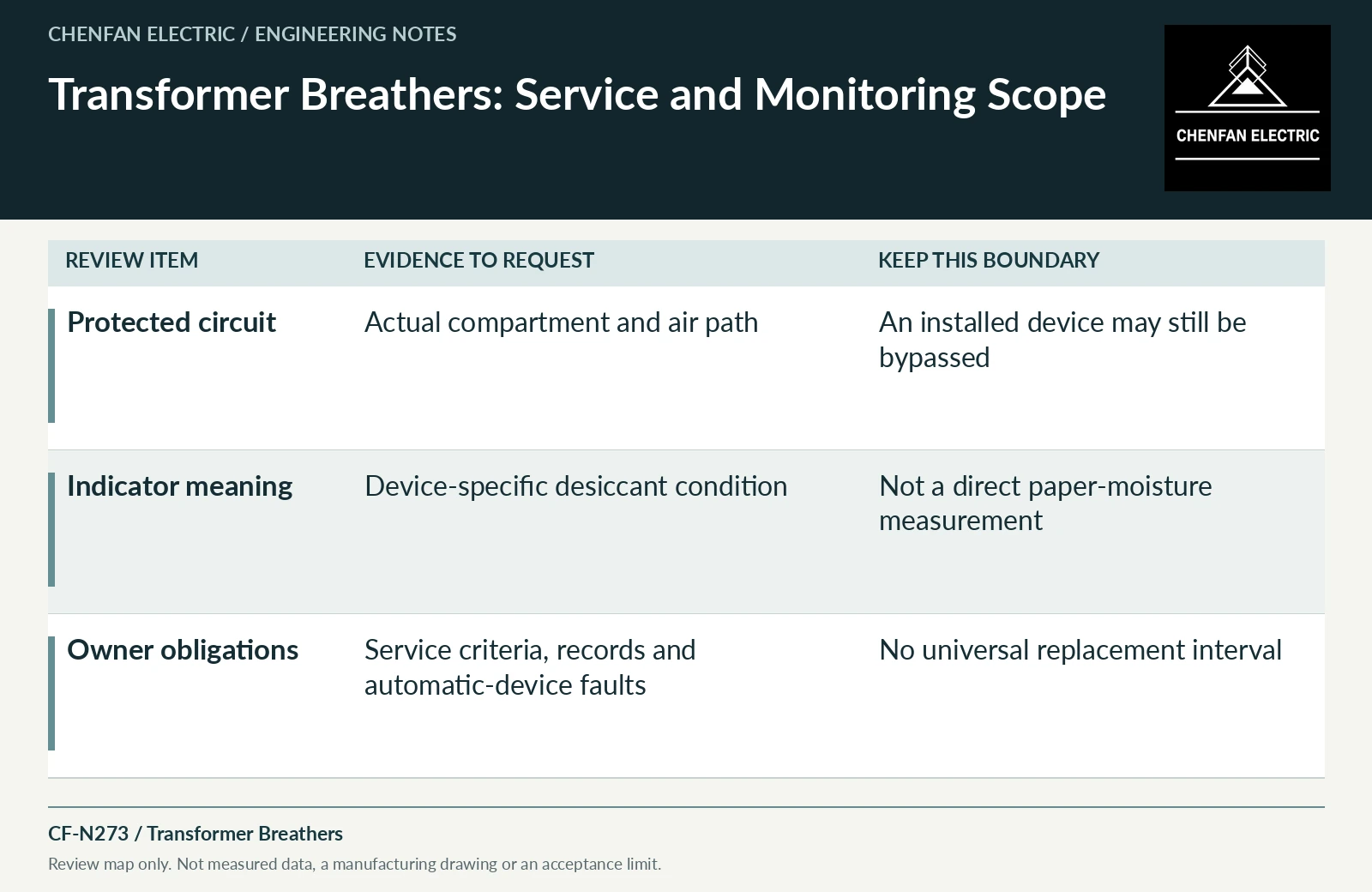
| Review item | Evidence to request | Boundary to preserve |
|---|---|---|
| Protected circuit | Actual compartment and air path | An installed device may still be bypassed |
| Indicator meaning | Device-specific desiccant condition | Not a direct paper-moisture measurement |
| Owner obligations | Service criteria, records and automatic-device faults | No universal replacement interval |
References and scope
- IEC 60076-1:2011 — Power transformers: GeneralPublic standard abstract · General transformer scope, interfaces and controlled equipment specification.
- IEEE C57.162-2025 — Interpretation of Moisture Related Parameters in Liquid Immersed Transformers and ReactorsPublic standard abstract · Moisture-related interpretation for liquid-immersed transformers; this is not a DGA guide.