

Transformer Core Engineering Notes · CF-N250
Fans can improve air-side heat removal, but transformer capacity is not determined by radiator airflow alone. Winding hot spots, internal oil circulation, insulation limits and current-carrying accessories may remain limiting. A cooling upgrade becomes an uprating only when the responsible OEM or qualified designer validates the complete modified transformer and its operating conditions.
Find the current limiting element
Review the existing thermal evidence and identify whether the restriction is external heat rejection, internal winding-to-liquid transfer or another component. Adding air movement addresses only some of these limitations. A lower top-oil temperature after installing fans is useful evidence, but it does not directly prove the maximum winding hot spot or the capacity of a tap changer. The upgrade proposal should state the original limit and how the modification changes it.
Review electrical and mechanical consequences
Higher load current increases winding and connection losses and changes thermal duty throughout the current path. Check bushings, leads, terminals and tap-changing equipment at the proposed load. The existing insulation condition and fault-duty assumptions may also need review. Do not assume that a cooler tank permits every internal component to carry more current. An uprating study must distinguish continuous capacity from a limited emergency load with specific initial conditions.
Integrate the fans as a complete subsystem
The fan arrangement needs suitable airflow distribution, guards, mounting, auxiliary power, protection and controls. Noise and maintenance access may change. Define how loss of the added cooling is detected and what load remains permissible. A temporary fan placed near a radiator is not equivalent to an engineered forced-air stage. Use the approved modification design and testing plan rather than improvising an operating procedure from observed temperature improvement.
Issue a documented modified rating
The completion record should state the accepted load, ambient conditions, cooling availability and any time limits. Identify the analysis and tests supporting the change, plus monitoring and maintenance obligations. Update operating documentation only after approval. If the evidence supports improved temperature margin at the original rating but not increased capacity, describe that benefit accurately. A useful upgrade does not need to be advertised as an uprating when the broader verification is absent.
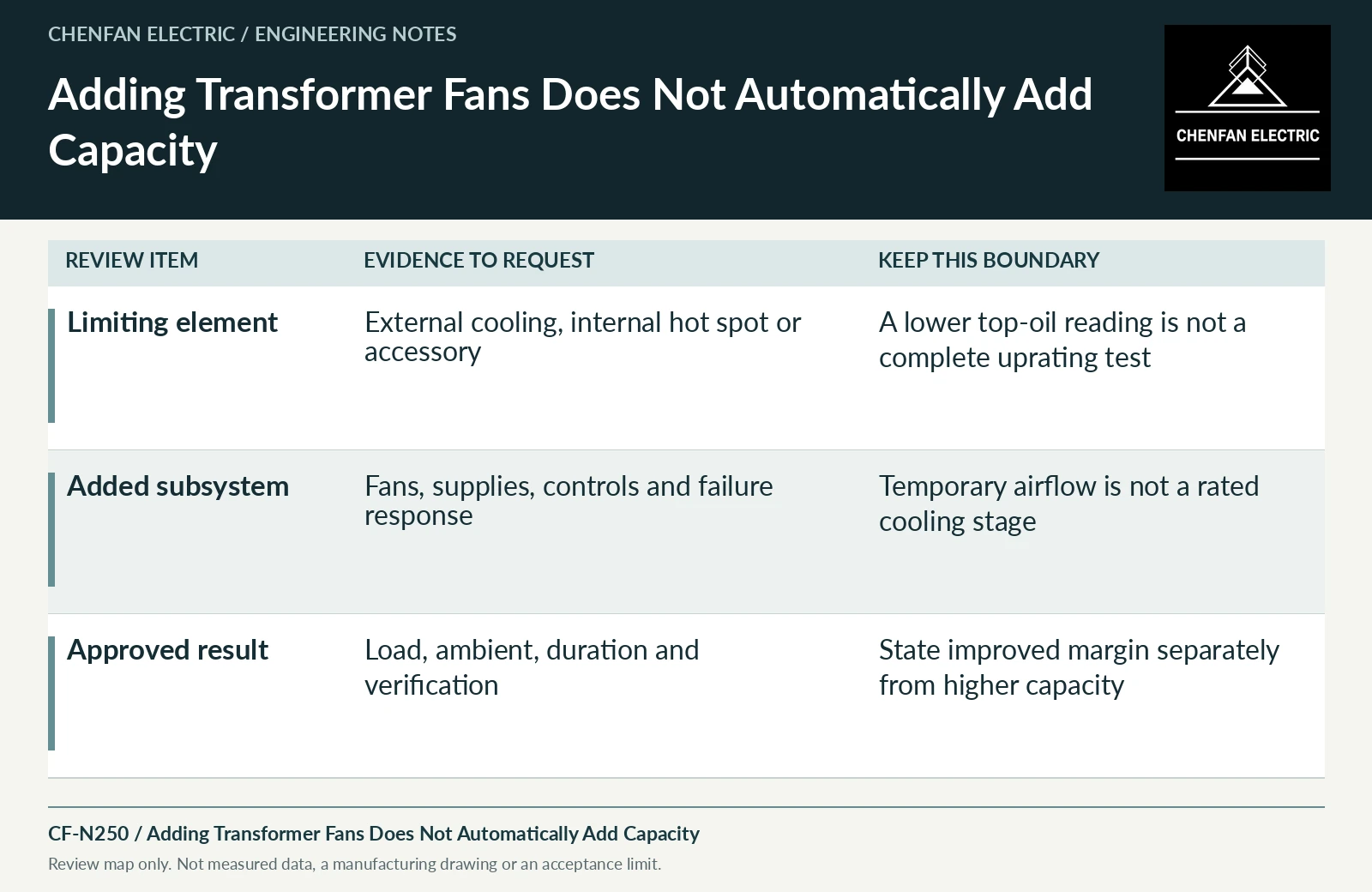
| Review item | Evidence to request | Boundary to preserve |
|---|---|---|
| Limiting element | External cooling, internal hot spot or accessory | A lower top-oil reading is not a complete uprating test |
| Added subsystem | Fans, supplies, controls and failure response | Temporary airflow is not a rated cooling stage |
| Approved result | Load, ambient, duration and verification | State improved margin separately from higher capacity |
References and scope
- IEC 60076-2:2011 — Temperature rise for liquid-immersed transformersPublic standard abstract · Temperature-rise requirements, cooling identification and the distinction between test conditions and installed duty.
- IEEE C57.91-2025 — Loading Mineral-Oil-Immersed Transformers and Step-Voltage RegulatorsPublic standard abstract · Mineral-oil loading, thermal duty and loading beyond nameplate; do not transfer the scope automatically to ester or dry-type equipment.
- IEEE C57.165-2024 — Temperature Monitoring of Liquid-Immersed TransformersPublic standard abstract · Temperature-monitoring methods for liquid-immersed transformers and their measurement/model boundaries.
- IEC 60076-5:2006 — Ability to withstand short circuitPublic standard abstract · Thermal and dynamic short-circuit capability; calculation and verification apply to the actual design.