


Transformer Core Engineering Notes · CF-N238
A pressboard support stack does not behave like an incompressible metal spacer. Its dimensions and mechanical response depend on material, moisture, processing and applied load. Winding clamping review should therefore address the intended condition after drying and assembly, and how the support system behaves over time—not simply the initial bolt-tightening value.
Define the stack in its relevant condition
Specify the pressboard grade, component dimensions, orientation where relevant and the state in which dimensions are measured. Nominal sheet thickness may differ from the compressed assembly dimension. The winding-height calculation should represent the approved processing and loading assumptions. Weidmann’s spacer guidance highlights dimensional consistency as a manufacturing consideration. That does not establish a universal compression factor: the actual material and qualified process must supply the design basis.
Distinguish tightening input from retained preload
A specified torque is an assembly input whose relationship to force depends on the joint and procedure. It is not automatically a direct measurement of retained winding preload. Changes in the insulation stack and thermal conditions can alter the load path. Ask the OEM how preload is established, verified and maintained within the design limits. Avoid prescribing a universal retightening schedule or torque value from a general article.
Balance restraint against material damage
Insufficient restraint can permit movement under fault forces, while excessive local loading can damage insulation or distort the intended geometry. The design must address contact areas and force transfer, not only total clamping force. Review end blocks, spacers, pressure rings and the supporting structure together. A change to one support material may alter the behaviour of the entire stack even if the overall drawing dimension appears unchanged.
Keep clamping evidence linked to short-circuit review
The mechanical verification should use support properties and dimensions representative of the delivered assembly. Record processing, inspection and approved preload controls so that the assumed condition can be traced. If a winding height, spacer grade or clamping arrangement changes, assess its effect on the original short-circuit evidence. A core clamp’s dimensional conformity is not proof that the complete winding support system retains the intended mechanical capacity throughout service.
| Review item | Evidence to request | Boundary to preserve |
|---|---|---|
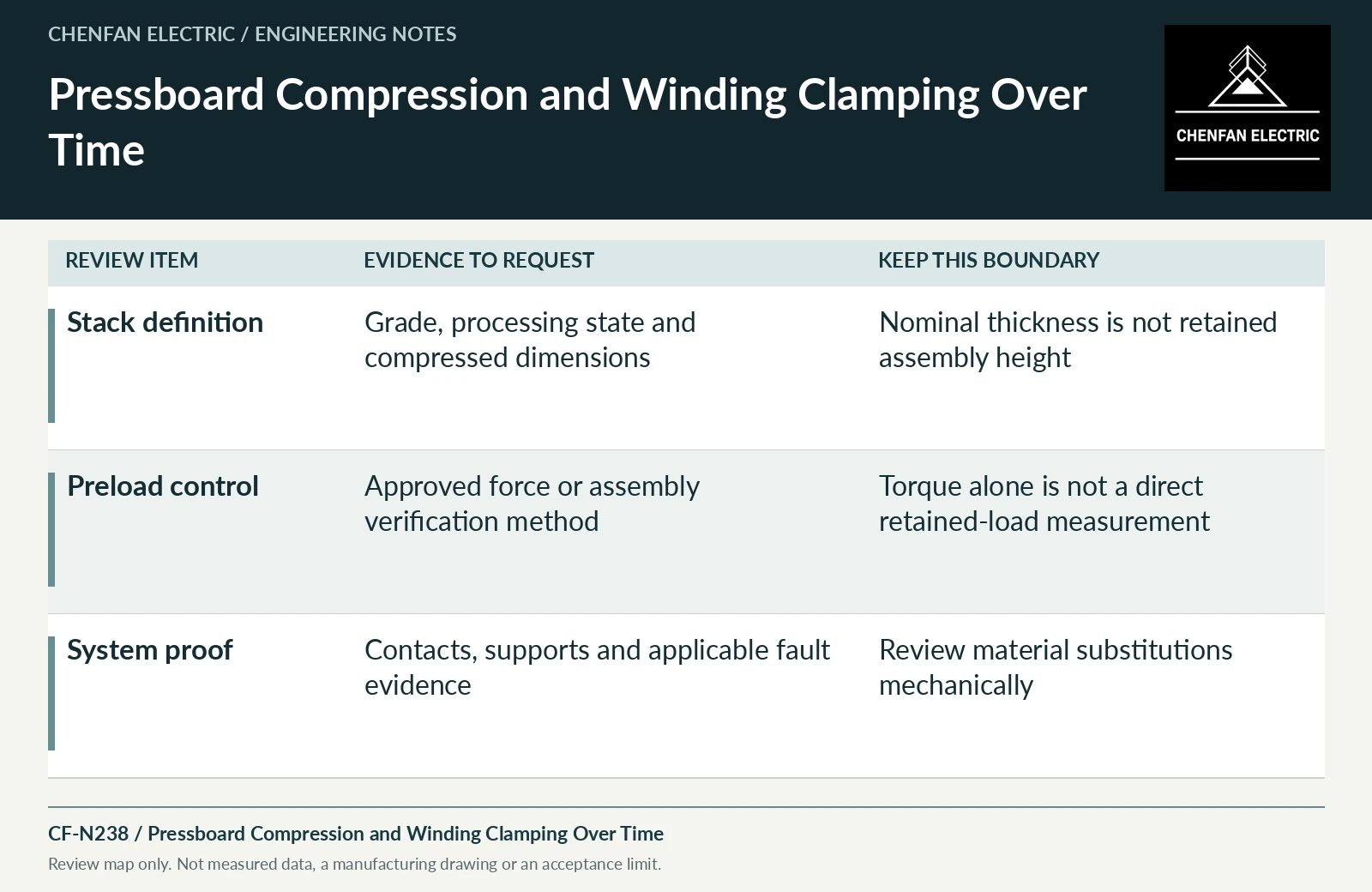
| Stack definition | Grade, processing state and compressed dimensions | Nominal thickness is not retained assembly height |
| Preload control | Approved force or assembly verification method | Torque alone is not a direct retained-load measurement |
| System proof | Contacts, supports and applicable fault evidence | Review material substitutions mechanically |
References and scope
- Optimizing transformer insulation systemsManufacturer technical page · Interaction of solid insulation, spacers, flow and mechanical support.
- Moisture protection of transformer insulation materialsManufacturer technical page · Moisture-sensitive handling, storage and protection of cellulosic insulation.
- IEC 60076-5:2006 — Ability to withstand short circuitPublic standard abstract · Thermal and dynamic short-circuit capability; calculation and verification apply to the actual design.