


Transformer Core Engineering Notes · CF-N239
Impregnation aims to establish the intended liquid-filled insulation structure after drying. A vacuum reading alone does not show that liquid has reached every relevant pore or space, or that gas has been adequately removed. The process must match the insulation geometry, fluid properties and equipment capability, with defined completion and handling controls.
Start with a known dry assembly
The drying record and subsequent exposure history establish the condition entering impregnation. If that condition is uncertain, the filling process should not be treated as an automatic correction. Identify the insulation materials, thicknesses and difficult-to-access regions represented by the qualified process. A simple empty-tank vacuum test says little about moisture or gas within a complex active part. Keep vessel integrity checks and insulation-processing evidence as separate but coordinated requirements.
Use the actual fluid and temperature basis
Viscosity and other fluid properties influence the assumptions used for flow and penetration. The process should identify the selected product, its condition and the approved temperature range. Do not transfer a filling sequence between mineral oil and ester without review. Likewise, avoid prescribing a universal heating temperature or hold time. The responsible manufacturer must define the procedure using its material system, equipment and validated production experience.
Respect tank and accessory limitations
Not every transformer tank or installed accessory is intended to withstand the same vacuum or pressure. The approved processing arrangement must identify which components are connected, isolated or otherwise treated according to the OEM procedure. This is not an invitation to alter valves or pressure settings from a general guide. The equipment’s mechanical limits and the site’s safety controls take precedence over an attempt to achieve a numerically impressive vacuum reading.
Document completion and readiness separately
A process record should show the required filling, holding and verification stages for the actual unit. Readiness for electrical testing or service may require additional waiting or checks defined by the manufacturer. Do not infer readiness from a full oil-level indication alone. Record the final liquid identity, process conditions and any deviations. The acceptance decision should cover the completed insulation system, not merely the performance of the vacuum pump during one stage.
| Review item | Evidence to request | Boundary to preserve |
|---|---|---|
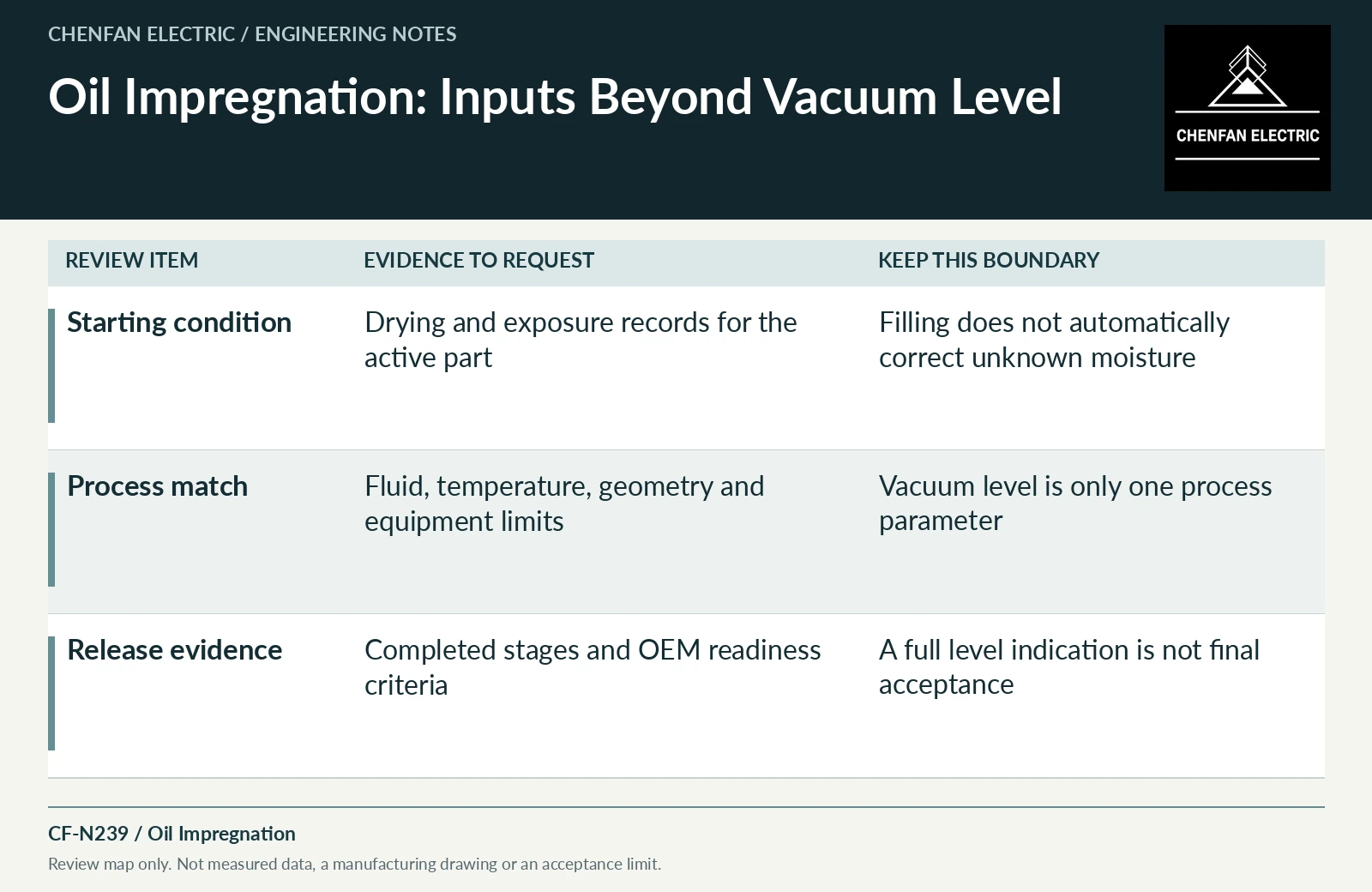
| Starting condition | Drying and exposure records for the active part | Filling does not automatically correct unknown moisture |
| Process match | Fluid, temperature, geometry and equipment limits | Vacuum level is only one process parameter |
| Release evidence | Completed stages and OEM readiness criteria | A full level indication is not final acceptance |
References and scope
- IEEE C57.162-2025 — Interpretation of Moisture Related Parameters in Liquid Immersed Transformers and ReactorsPublic standard abstract · Moisture-related interpretation for liquid-immersed transformers; this is not a DGA guide.
- Retrofilling with FR3 fluidManufacturer application page · Retrofill is an equipment/material/process review, not a nameplate uprating by fluid substitution alone.
- IEEE C57.100-2022 — Thermal Evaluation of Insulation Systems for Liquid-Immersed TransformersPublic standard abstract · Thermal evaluation of insulation systems for liquid-immersed transformers; not a dry-type qualification reference.