


Transformer Core Engineering Notes · CF-N205
Conductor shape affects packing, bending and field exposure, but does not by itself determine transformer efficiency. Round and rectangular wire should be compared as insulated, manufactured windings. The useful question is how each choice changes the finished envelope, loss distribution, cooling routes and manufacturing tolerances for the required turns and current.
Packing factor is not just bare-metal geometry
Rectangular conductors can use space differently from round conductors, but rounded corners, insulation build and placement tolerances still occupy area. A theoretical packing comparison that omits those features overstates the available window saving. Count the actual turns in each layer, crossover space and insulation between layers. The core window must accommodate the assembled winding, not a drawing of perfectly packed bare conductors with no allowance for insertion or dimensional variation.
Orientation belongs in the loss calculation
A rectangular cross-section has different dimensions in its two directions. Its orientation relative to leakage field can therefore matter to additional losses and the choice of strand subdivision. Two windings with equal DC resistance may not have equal AC losses. Request the conductor dimensions used in the loss calculation and their orientation in the winding section. Keep any proposed reduction in conductor thickness linked to the resulting change in turns, parallel paths and insulation content.
Forming and insulation must survive production
The required bend geometry depends on conductor size, material condition and insulation system. Avoid assigning a universal bend radius from shape alone. Review how the supplier controls corner quality, coating integrity and conductor positioning through winding and lead forming. For either shape, a compact design is not beneficial if its production tolerances leave insufficient clearance or damage insulation. Acceptance should refer to the actual process and finished assembly, not only the incoming wire certificate.
Compare completed proposals on common guarantees
A meaningful comparison lists finished coil dimensions, no-load and load losses, reference temperature, cooling method and the applicable verification evidence. Explain any change in core dimensions caused by the winding choice. Avoid treating a wire-shape substitution as an automatic cost saving: different tooling, joins or inspection needs may offset material benefits. A buyer can then compare the complete design without prescribing conductor shape more tightly than the project actually requires.
| Review item | Evidence to request | Boundary to preserve |
|---|---|---|
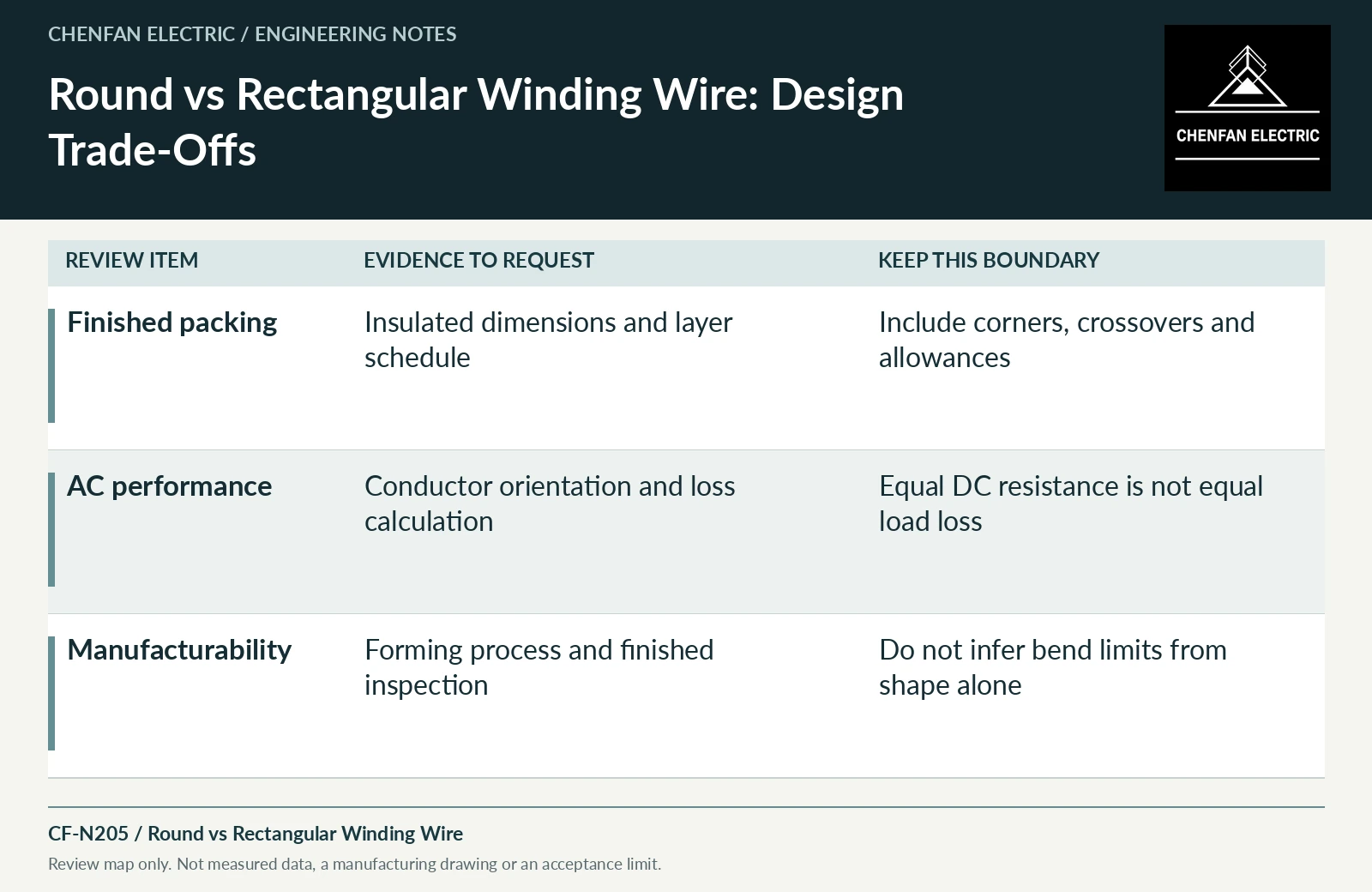
| Finished packing | Insulated dimensions and layer schedule | Include corners, crossovers and allowances |
| AC performance | Conductor orientation and loss calculation | Equal DC resistance is not equal load loss |
| Manufacturability | Forming process and finished inspection | Do not infer bend limits from shape alone |
References and scope
- Continuously Transposed Cable (CTC)Manufacturer technical page · Strand arrangement and transposition concept; supplied dimensions and restrictions require the current product specification.
- IEC 60076-2:2011 — Temperature rise for liquid-immersed transformersPublic standard abstract · Temperature-rise requirements, cooling identification and the distinction between test conditions and installed duty.
- IEC 60076-5:2006 — Ability to withstand short circuitPublic standard abstract · Thermal and dynamic short-circuit capability; calculation and verification apply to the actual design.