

A mobile-substation transformer should be specified for separate transit, deployed-operation and storage configurations. Rough-route transport, temporary foundations, changing ambient conditions and repeated connection work can impose different requirements. A transformer that performs electrically at one site is not automatically qualified for an undefined transport route, and a transportable package is not automatically ready to operate in every deployed arrangement.
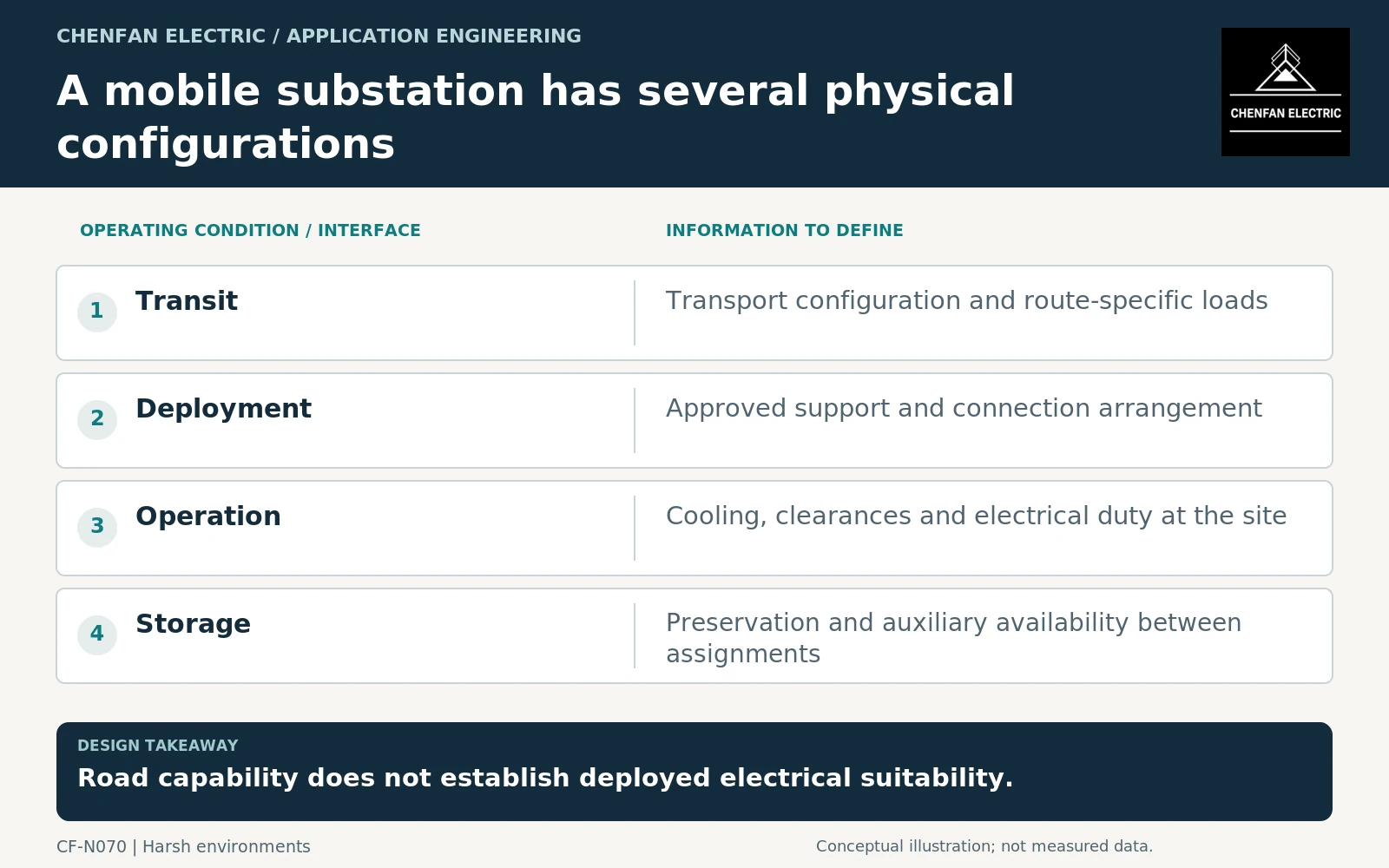
Define the physical configurations explicitly
Record which components remain attached during transit and which are installed only at the operating site. State masses, dimensions and support interfaces for each configuration. Do not use an operating overall mass as a substitute for the actual transit mass distribution.
The transport input should come from the route and platform design, including relevant mechanical exposure and handling boundaries. This article does not determine axle loads, road permissions, lifting equipment or field deployment procedures.
General transformer requirements provide an equipment framework, but unusual mechanical and environmental conditions must be stated and agreed. [1] A generic “mobile duty” label leaves those conditions unresolved.
Review deployed operation as a separate installation
At the operating site, the transformer needs the specified support, electrical clearances, cooling conditions, grounding arrangement and connection interfaces. Temporary installation does not remove those requirements.
The electrical duty may vary between assignments. Define the supported voltage ranges, tap philosophy, current envelope and network conditions, then identify what must be reviewed before use at a new site. General transformer application guidance addresses these operating and connection considerations. [2]
Cooling can differ between transit packaging and the deployed arrangement. Removable radiators, fans or external services should have explicit installation and performance boundaries. The cited fan and fittings standards concern accessories of liquid-immersed power transformers and reactors; they do not qualify the complete mobile package in every physical configuration. [3] [4]
A useful deployment record links the selected electrical configuration to the exact installed accessory arrangement. It should not rely on memory about which parts were fitted during the previous assignment.
Preserve condition between moves
Repeated transport and storage create a need for approved inspection, preservation and return-to-service requirements. The supplier should identify what evidence is required after the specified exposure and before operation. Do not invent a universal post-transport test or energization checklist without the equipment instructions.
The storage case should state duration, environmental exposure and auxiliary-power availability. A unit parked between assignments may face condensation or temperature conditions different from energized service.
The procurement package should therefore contain three coordinated schedules: transit configuration and loads, deployed electrical and environmental duty, and storage/preservation assumptions. Assign responsibility for the vehicle or platform, transformer assembly, site supports and external connections.
Acceptance should compare the delivered package with each assessed configuration. Changes to accessory locations, support brackets or transport restraints can alter the relevant evidence even when the transformer rating is unchanged.
The practical result is a bounded mobile capability: a defined assembly can be transported under stated conditions and operated in stated deployed configurations. “Suitable for harsh terrain” is not a complete technical promise unless the route, supports, connections and operating environment behind that phrase are made explicit.
Core procurement checkpoint: Control the mobile unit’s delivery and operating configurations
For a mobile installation, specify whether the supplied core is loose, pre-stacked or assembled and how it interfaces with the transformer’s transport restraints. The complete-equipment designer must approve transit and operating arrangements separately. A core outline or material certificate cannot qualify a mobile substation for repeated transport, rough terrain or operation with altered ventilation and service clearances.
For the core enquiry: Core/clamp interface drawing; delivery state; transport-restraint responsibility; receiving instructions; operating versus transit configuration references.