

An automated line can reproduce a wrong packet recipe with high positional consistency.
It can remove placement variation while carrying a different error through the whole run.
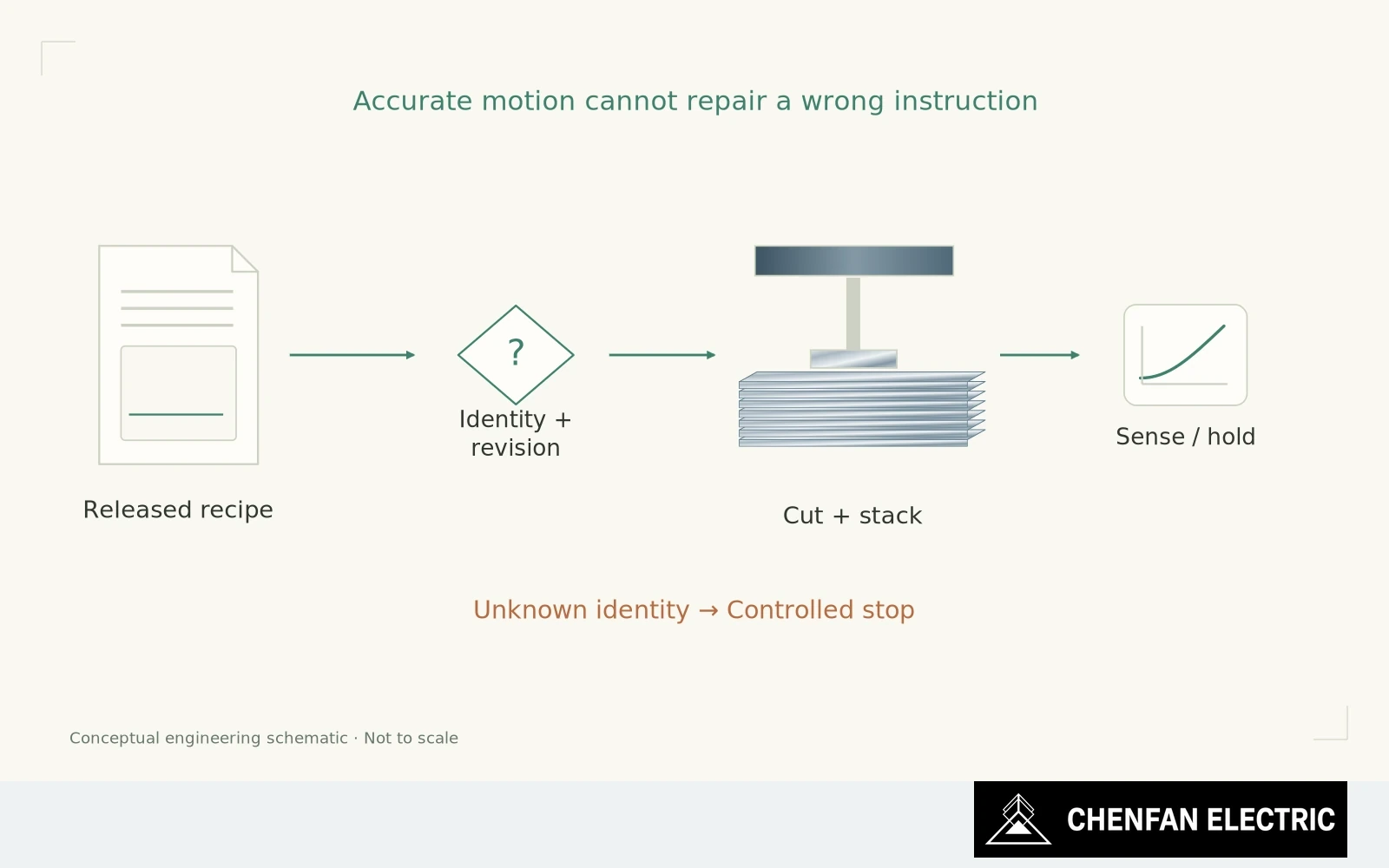
Separate programmed control from AI judgement
Core cutting and automated stacking systems can control motion, sequence and repeated handling more consistently than an uncontrolled manual route. Their value still depends on the correctness of the input, the qualified operating range and the evidence used to verify the output.
Separate deterministic control from AI-based judgement. A programmed cut length or interlocked material identifier has a different failure mode from a vision model classifying a surface anomaly. Calling both “smart manufacturing” makes the controls harder to review, not easier.
For cutting and pre-stacking, verify the chain from released drawing to executable recipe. Width, gauge, step sequence, packet identity and revision need to stay connected. A correctly executed obsolete program is still the wrong manufacturing instruction.
Verify measurement coverage and uncertainty response
For automated measurement, establish calibration, repeatability and suitable access to the feature. A sensor cannot verify a concealed interface that it never observes. A clean measurement of the outer stack does not prove that the internal sequence is correct.
For vision-based inspection, define what counts as a defect and validate against independently checked examples. Changes in coating appearance, lighting or material mix can alter performance. False acceptances and false rejections have different consequences and should be evaluated separately.
The system also needs an explicit response to uncertainty. An unreadable identity, an unexpected sheet pickup or an unrecognized surface condition should lead to a defined hold or review, not an unrecorded operator workaround that teaches the production line to ignore its own controls.
Connect magnetic results back to process control
Final magnetic testing remains valuable because some process errors are not captured by the available sensors. The test should be connected to the manufacturing record so that an anomaly can improve the process rather than merely reject the product.
Engineers still own the causal judgement: which variable matters, whether a change is within qualification, and what evidence is sufficient to release the result. Automation can support those decisions; it cannot make an undefined acceptance criterion objective.
Evaluate the system by the errors it prevents, detects and contains under normal production changes. Cycle time is one result. A traceable, correctly configured core is the result the customer actually needs.
Practical takeaway
Precise automation can reproduce a wrong recipe unless identity and revision control are equally strong.
Chenfan Electric manufactures custom transformer cores according to customer drawings. Where applicable to the specified material and core design, agreed process controls include burr height below 0.02 mm and stacking factor above 97%. Measurement methods and acceptance conditions are defined for each order.