

What does the loss margin cover that the building factor has not already covered?
Without that answer, a design can be under-protected or carrying the same allowance twice.
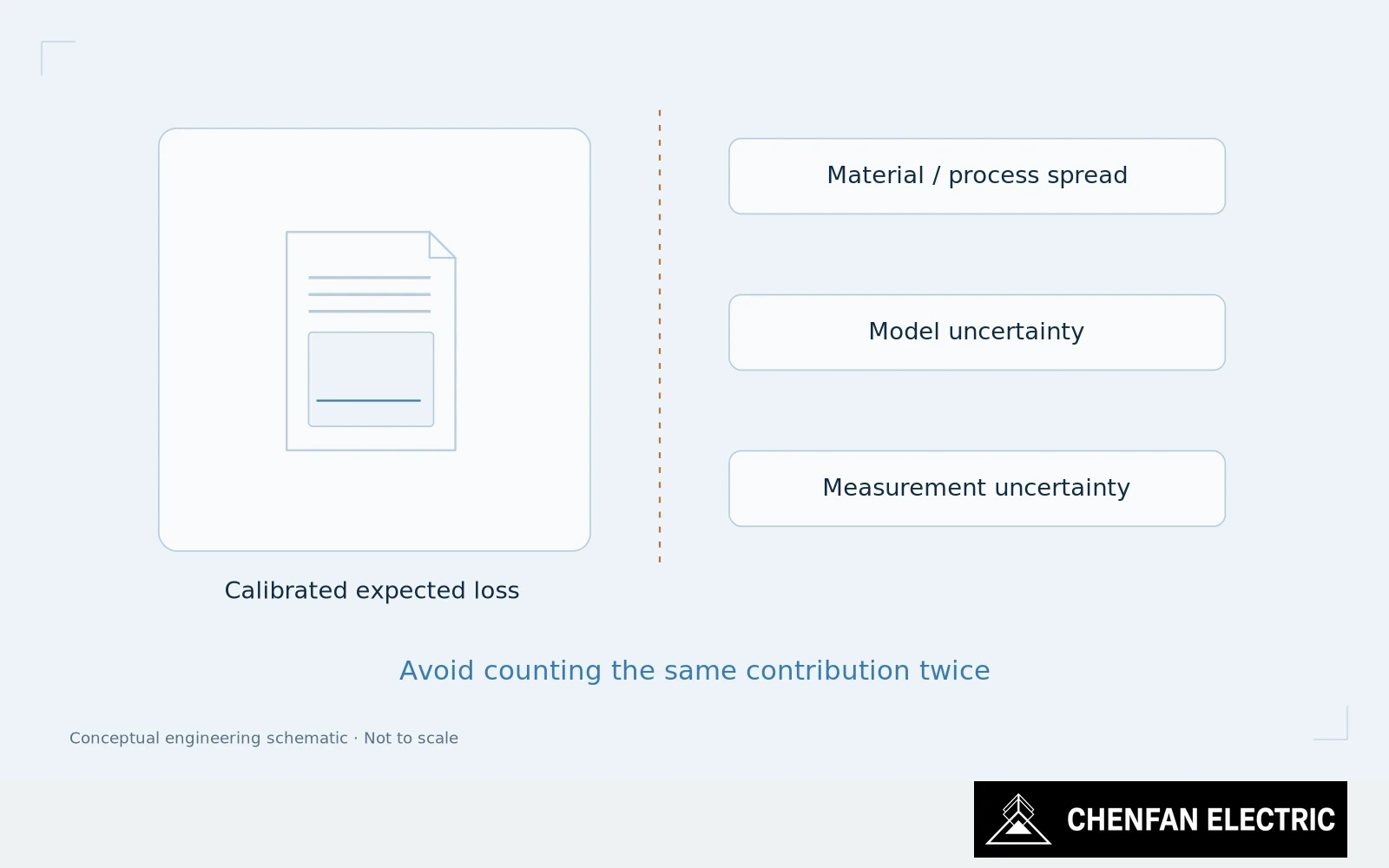
Separate expected behaviour from remaining uncertainty
Start by separating expected behaviour from uncertainty. A calibrated prediction may already include the average effect of joints and manufacturing for a defined core family. Adding another blanket “manufacturing penalty” can duplicate that expected contribution rather than address its variation.
The remaining uncertainty has several possible sources: material variation, process variation, model error, measurement uncertainty and changes between the tested core state and the final transformer. They need not have the same size, distribution or degree of independence.
Known systematic error should be corrected where possible, not hidden indefinitely inside a large margin. Random variation needs suitable production evidence. An unvalidated new geometry is a knowledge gap and may require qualification rather than a confident percentage copied from a mature design.
Check variation, dependence and the acceptance endpoint
Measurement uncertainty also has a distinct role. It helps define how a reported value relates to the quantity being measured and how an acceptance decision is made near a limit. It should not be casually added as if it were another physical source of core loss.
Use comparable data to estimate the production spread. Mixing different designs, test conditions and reworked results can create a margin that describes the database rather than the intended manufacturing route. A few favourable trials are not enough to establish a reliable tail estimate.
Check dependence before combining allowances statistically. Several contributors may move together because they share a material batch, process condition or model assumption. An independence assumption can make the calculated protection look stronger than the evidence supports.
Review the allowance as qualification evidence improves
The commercial requirement matters too. Define whether the limit applies to the core test, the complete-transformer test or both, and which conversion or correlation has been validated between those states.
Review the margin as evidence improves. A stable production family may justify a different allocation from a new design with an unfamiliar joint or handling route. Keeping the same number forever is not necessarily conservative engineering.
The final margin should be explainable as a decision based on the specified endpoint, corrected prediction and remaining uncertainty. There is no universal percentage that can do that work for every transformer core.
Practical takeaway
An undefined margin can double-count the building factor while missing the uncertainty that actually matters.
Chenfan Electric manufactures custom transformer cores according to customer drawings. Where applicable to the specified material and core design, agreed process controls include burr height below 0.02 mm and stacking factor above 97%. Measurement methods and acceptance conditions are defined for each order.