

An intact crate can surround a core that no longer matches its released condition.
Packaging acceptance needs to describe what is protected inside, not only the strength of the outer box.
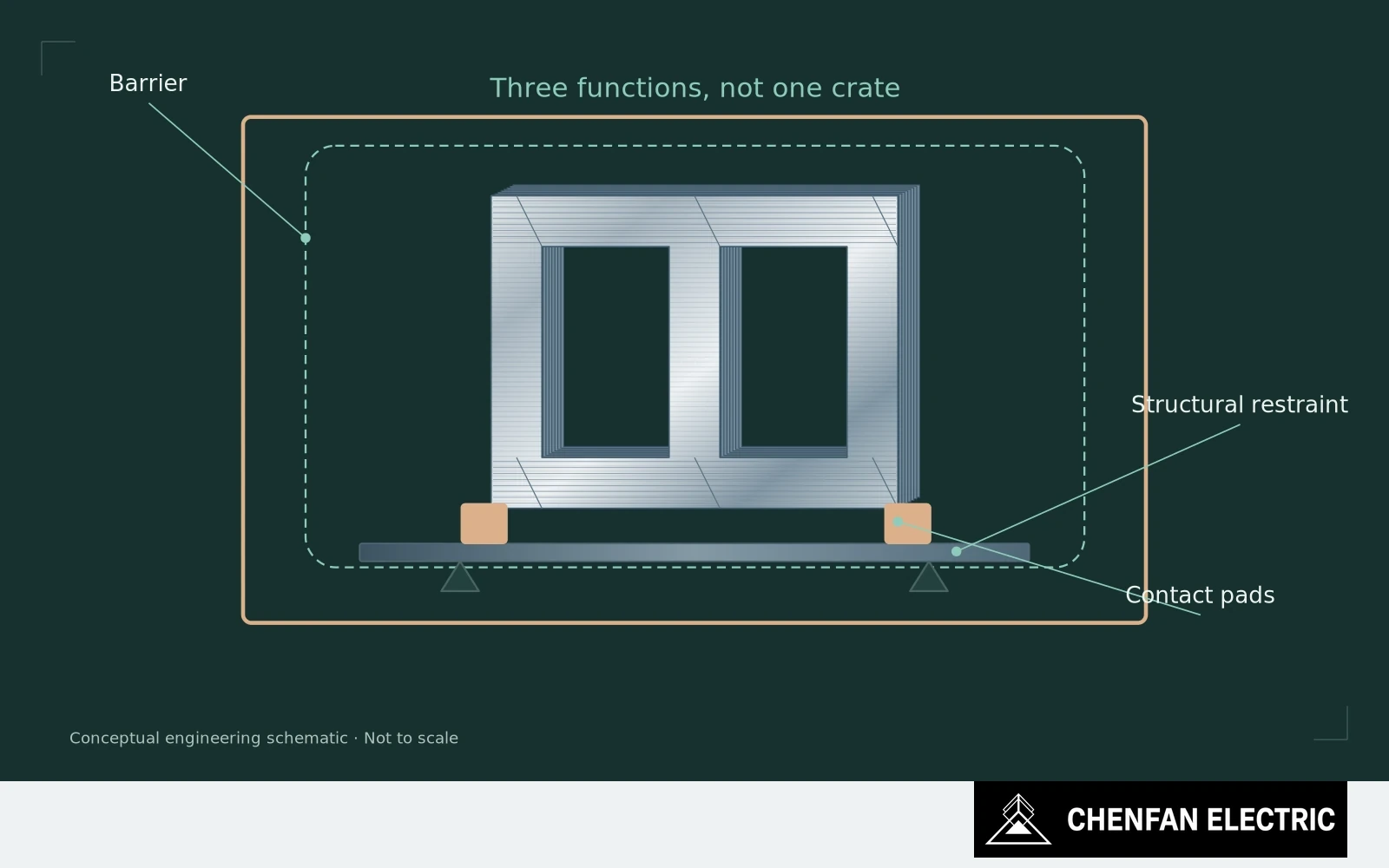
Separate support, restraint and barrier functions
For an assembled core, mechanical protection begins at the contact points. The package needs defined supports and restraints that work with the approved core structure. A tie-down can prevent gross movement while applying an unsuitable local force to a lamination packet or an exposed interface.
Separate the jobs of the packaging elements. A barrier controls environmental exposure. Blocking and restraints control movement. Contact protection prevents damage at interfaces. None of these functions proves that the others have been achieved.
The design also needs to survive the expected transport and handling sequence. A package that works on a factory floor may encounter different load directions during transfer. The relevant conditions should be assessed by competent packaging and handling engineers for the actual route and cargo.
Check preservation and unpacking compatibility
Moisture control has its own starting condition. Sealing damp materials inside a barrier can preserve the moisture source as effectively as it excludes outside air. Desiccant quantity alone is not a specification unless barrier performance, enclosed materials and the intended protection period are considered.
For the core itself, assess the compatibility of contact materials and any temporary protective treatment with subsequent assembly. A coating or residue that is acceptable on ordinary machinery is not automatically acceptable at a transformer-core interface.
Receiving instructions complete the package. Identify where it may be supported, which protection is temporary, what should be inspected before disturbance and what storage conditions apply after opening. Packaging that requires an improvised unpacking sequence has left part of the protection problem unresolved.
Verify the protected core state before concealment
Verification should focus on evidence of the intended functions: the correct restraint configuration, protected contact points, suitable barrier closure and a record of the condition before concealment. A photograph of a finished wooden box cannot establish those internal details.
This does not mean every core needs the same elaborate export package. Loose laminations, partial assemblies and heavy complete cores present different risks. The specification should follow the delivered configuration and exposure.
The acceptance question is whether the package preserves a defined, usable core state through the agreed journey. “It will not fall apart” is only one part of that requirement.
Practical takeaway
Package integrity and preservation of the core configuration are separate acceptance questions.
Chenfan Electric manufactures custom transformer cores according to customer drawings. Where applicable to the specified material and core design, agreed process controls include burr height below 0.02 mm and stacking factor above 97%. Measurement methods and acceptance conditions are defined for each order.