

A larger core does not automatically have a worse building factor.
It may, however, fall outside the evidence used to predict that factor.
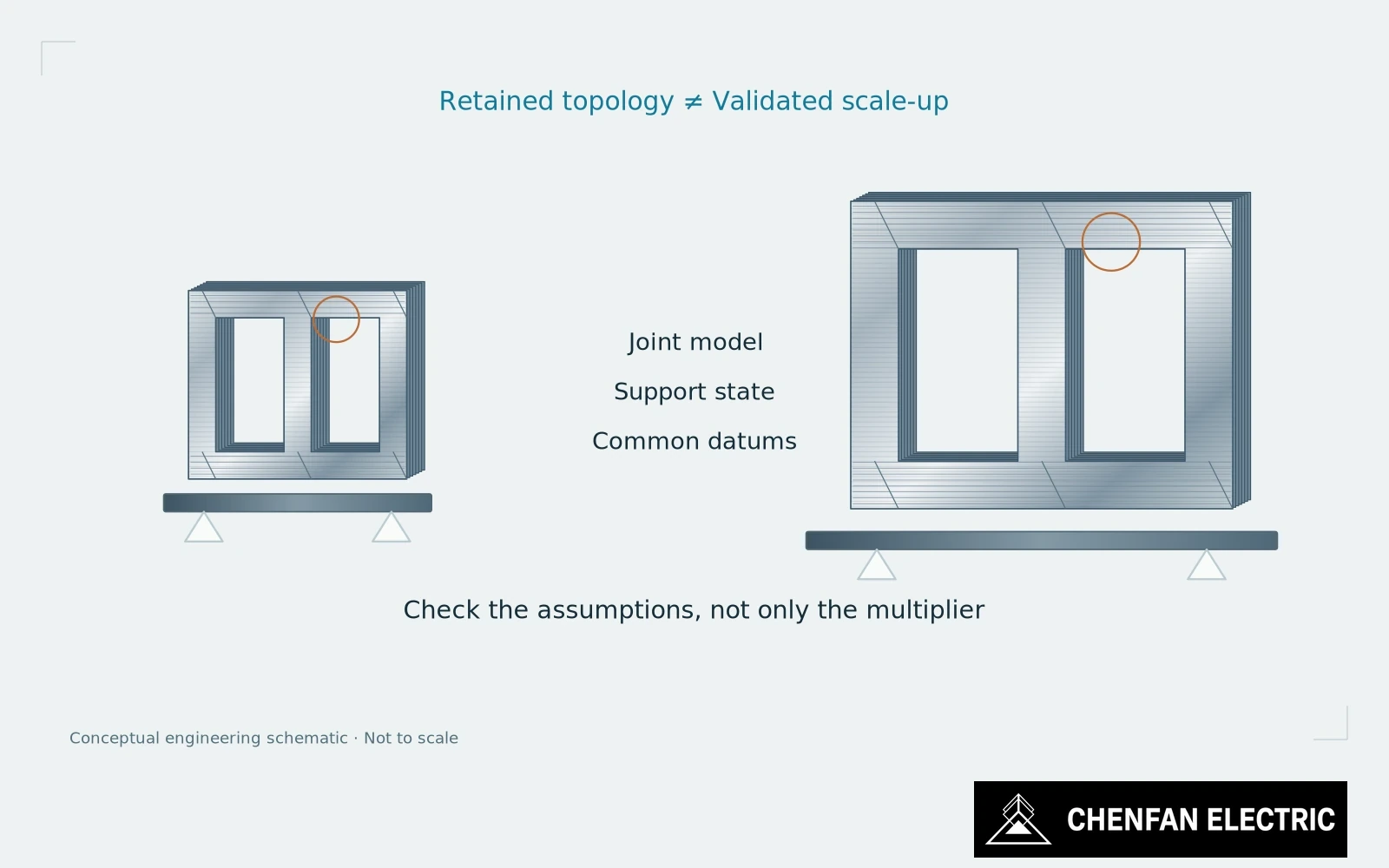
Identify geometry and mechanical changes
Those are different statements, and the distinction matters when a familiar design family moves to a larger rating.
Size alone does not determine the number of magnetic joints. A geometrically similar enlargement may retain the same joint topology. Other design changes can add packets, alter cross-sections or introduce different structural constraints. The actual configuration, not the tonnage label, determines the modeling problem.
The first uncertainty is geometric representation. Are the joint regions and local sections described well enough for the intended estimate, or has a small-core correction simply been carried over? A longer straight limb does not necessarily add loss in the same proportion as a changed joint arrangement.
Review variation and the qualified reference range
The second is mechanical representation. Support spans and clamping layouts may change. If the large core reaches a different stress or seating state, small-core experience may no longer represent the delivered assembly.
The third is variation. Many small dimensional deviations do not necessarily cancel. A common datum error or a systematic cutting offset can move an entire group of parts in the same direction. Treating every deviation as independent can understate uncertainty.
This suggests a more useful scale-up review than adding a blanket percentage. Identify what remains equivalent to the reference design, what changes, and which changed assumptions have the greatest influence on predicted loss.
Where uncertainty is concentrated in one feature, qualification should challenge that feature. A representative joint assembly, a controlled dimensional study or a core from the new design family may answer more than a broad collection of unrelated historical results.
Target the assumptions that need fresh evidence
Keep measurement uncertainty separate from the model’s uncertainty. A more accurate wattmeter does not correct an unrepresentative joint model; a more detailed model does not remove an error in the test connection.
The prediction should be presented with its evidence boundary: the materials, geometry family, operating range and assembly conditions for which it has been checked.
The issue with a large core is not that its loss is unknowable. It is that scaling the output number is easier than demonstrating that the assumptions still hold. The review should spend its time on the assumptions that changed.
Practical takeaway
Larger size does not guarantee poorer performance, but it can invalidate a familiar prediction model.
Chenfan Electric manufactures custom transformer cores according to customer drawings. Where applicable to the specified material and core design, agreed process controls include burr height below 0.02 mm and stacking factor above 97%. Measurement methods and acceptance conditions are defined for each order.