

Before adjusting the building factor, check what the calculation actually counted.
A fitted multiplier can hide a wrong mass, a wrong operating point or a missing physical effect just as easily as it can represent manufacturing experience.
Verify the inputs and modeled physical effects
The simplest loss estimate multiplies an appropriate material-specific loss by the relevant iron mass. It is useful only if the material point, mass definition and intended magnetic condition belong together.
A real core does not expose every kilogram to an identical magnetic history. Limbs, yokes and joints can have different local conditions. Flux redistribution, departures from the rolling direction and assembly stresses complicate a uniform-material estimate.
A more detailed model may include some of those effects explicitly. That changes the role of any empirical correction applied afterward. A factor calibrated for a simple mass-times-W/kg model should not automatically be applied to a model that already resolves the joints.
Separate model bias from production scatter
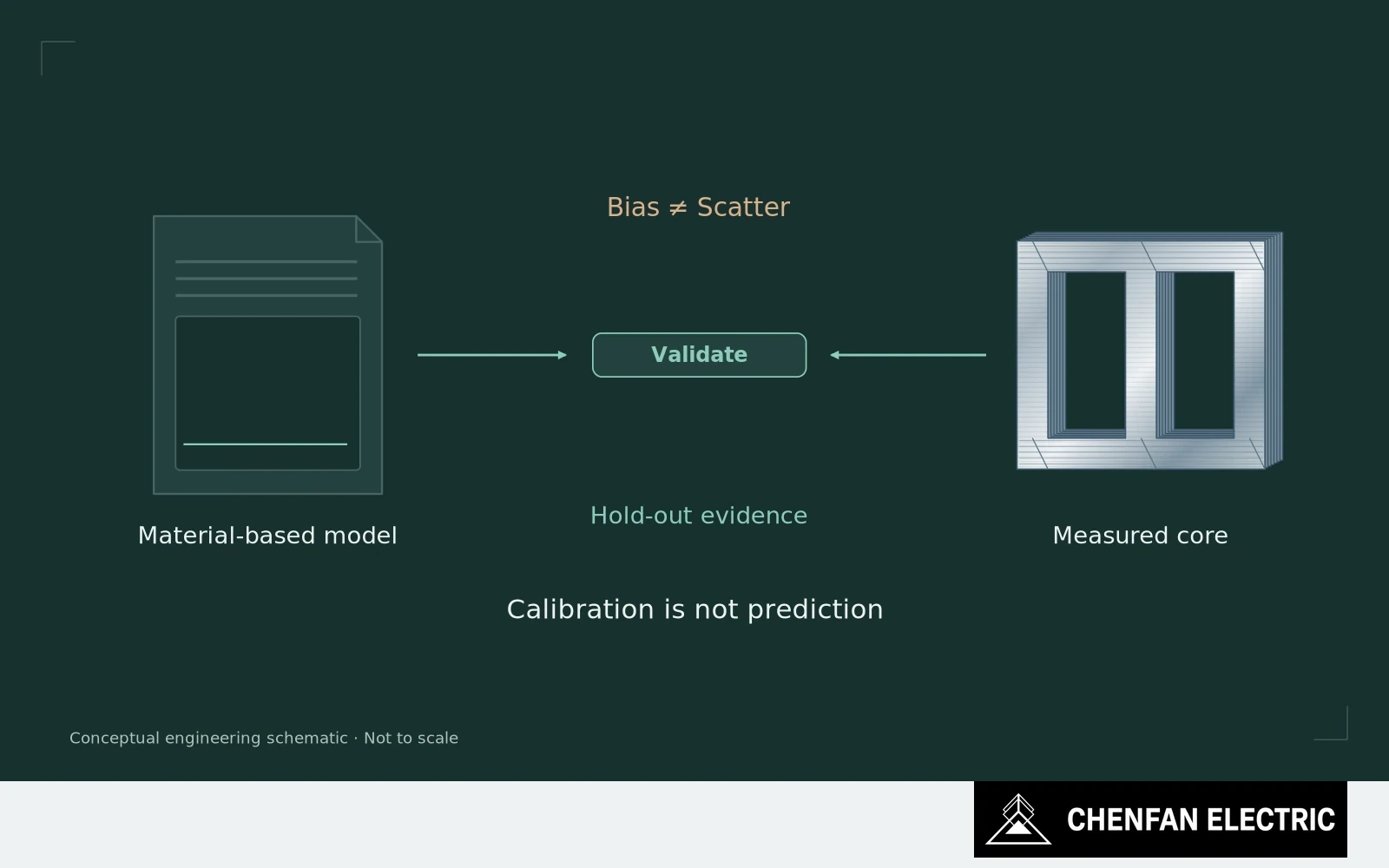
There is also a distinction between model bias and production scatter. If comparable cores repeatedly differ from the calculation in the same direction, investigate a systematic assumption. If the differences vary materially between units, examine manufacturing and measurement variation rather than merely moving the predicted mean.
Calibration should use comparable designs and clearly defined test conditions. Mixing different frequencies, induction levels, material routes or core configurations into one correction factor can create an apparently impressive fit with little predictive value.
Keep some observations outside the calibration set. A factor that reproduces the cores used to derive it has passed a fitting exercise; it has not yet demonstrated prediction for the next order.
Validate predictions beyond the calibration set
When a calculation and a measurement happen to agree exactly, that does not prove the model is complete. Different errors can offset, and a reported number has finite resolution. Conversely, a small difference is not automatically evidence of poor manufacture.
The engineering task is to explain the expected discrepancy and its uncertainty at the point where the design decision is made. Record which effects are explicit, which are empirical and which remain unquantified.
That record is more useful than a permanently increasing correction factor. It tells the next engineer whether a new core design belongs inside the model’s qualified range or requires fresh evidence.
Practical takeaway
An empirical correction can conceal an incorrect input or double-count an effect already modeled.
Chenfan Electric manufactures custom transformer cores according to customer drawings. Where applicable to the specified material and core design, agreed process controls include burr height below 0.02 mm and stacking factor above 97%. Measurement methods and acceptance conditions are defined for each order.