

A loss budget can disappear without a single dramatic manufacturing error.
Several small changes may be involved, but assigning a fixed penalty to every factory operation will not explain them.
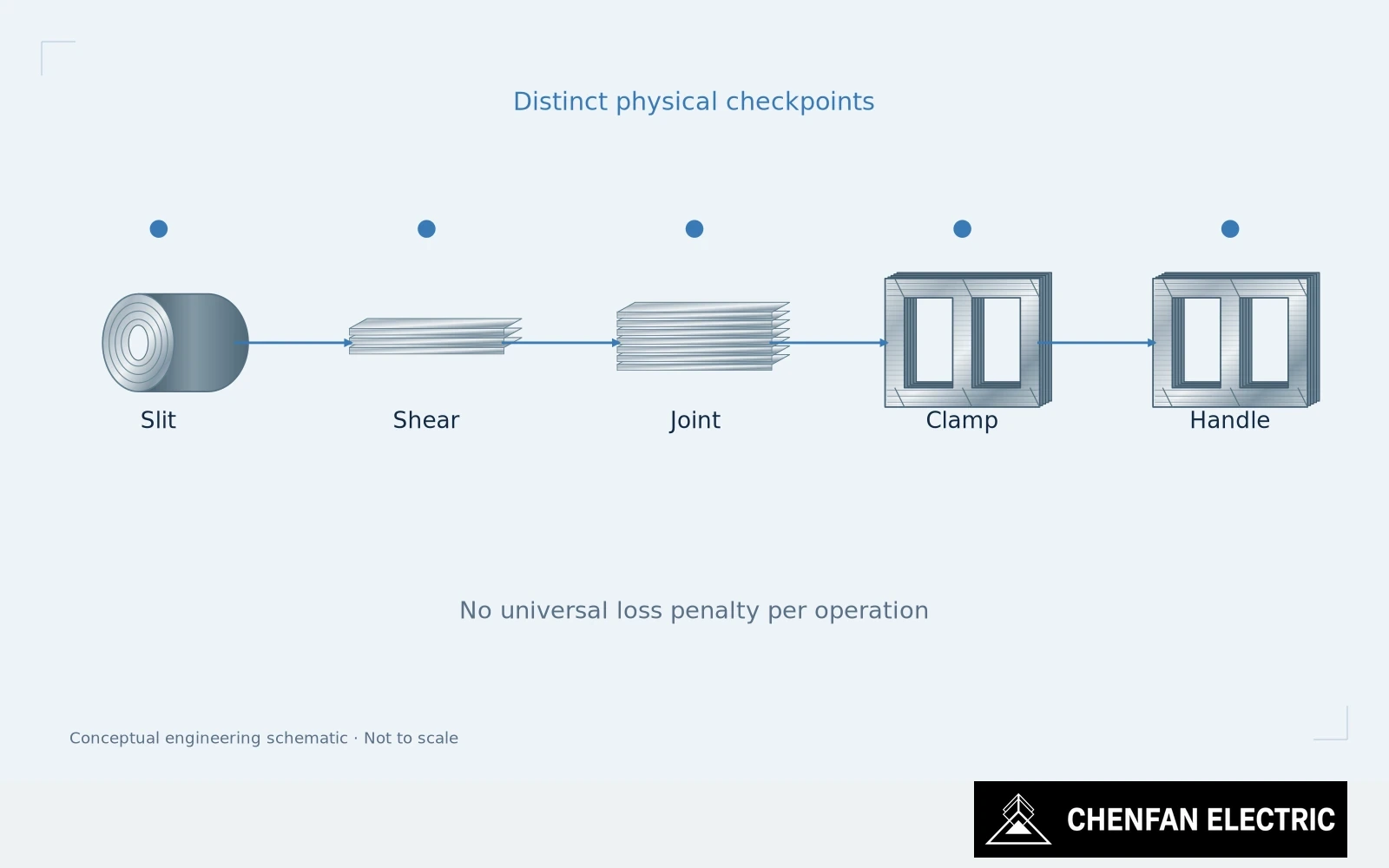
Follow changes from slitting to magnetic assembly
Start at slitting. The relevant change is not merely that a wide coil becomes narrow strips. New edges and a new handling history have been introduced. Edge condition and deformation need to be evaluated in relation to the strip width and the process, rather than assigned a universal loss allowance.
At cut-to-length, the question changes. The operation creates the geometry that will form the magnetic joints. A cut can satisfy its length tolerance while the edge condition or angular relationship still deserves attention.
At stacking, those individual parts acquire a relationship to one another. Step sequence, packet position and local seating now affect the magnetic path. These are assembly variables; they are not additional properties that appeared on the original steel certificate.
Control clamping and handling states
Clamping introduces another state. The intended mechanical restraint must be achieved without assuming that magnetic response varies monotonically with applied force. Stress direction, distribution and material condition matter.
Handling and final integration may change seating or restraint again. They may also leave the condition unchanged. The purpose of a control plan is to distinguish those outcomes, not to presume damage at every transition.
This is why a process-loss investigation needs checkpoints around the operation being examined. Use comparable samples or the same assembly where the comparison is valid. Preserve the electrical test conditions and record the mechanical state.
Avoid counting the same process effect twice
Do not add independently estimated “cutting,” “joint” and “clamping” penalties if the building factor used in the design already includes them. That produces double counting, not conservatism. The effects can also interact, so a simple sum may misrepresent the route.
For production improvement, select the stage where evidence shows an avoidable change. Tightening every control at once may increase inspection work without identifying which operation was consuming the margin.
A route is understood when a change can be located, reproduced and reduced without shifting the problem elsewhere. The final watt reading is the endpoint of that investigation, not its map.
Practical takeaway
Several small process changes can consume margin, but fixed stage penalties can double count the same effect.
Chenfan Electric manufactures custom transformer cores according to customer drawings. Where applicable to the specified material and core design, agreed process controls include burr height below 0.02 mm and stacking factor above 97%. Measurement methods and acceptance conditions are defined for each order.