

Before ordering a different CRGO grade, repeat the loss measurement you are about to blame it for.
A high finished-core result has several possible origins. The fastest route to a useful answer is not to inspect everything at once. It is to eliminate explanations in an order that preserves evidence and avoids unnecessary rebuilding.
Verify the electrical state and calculation
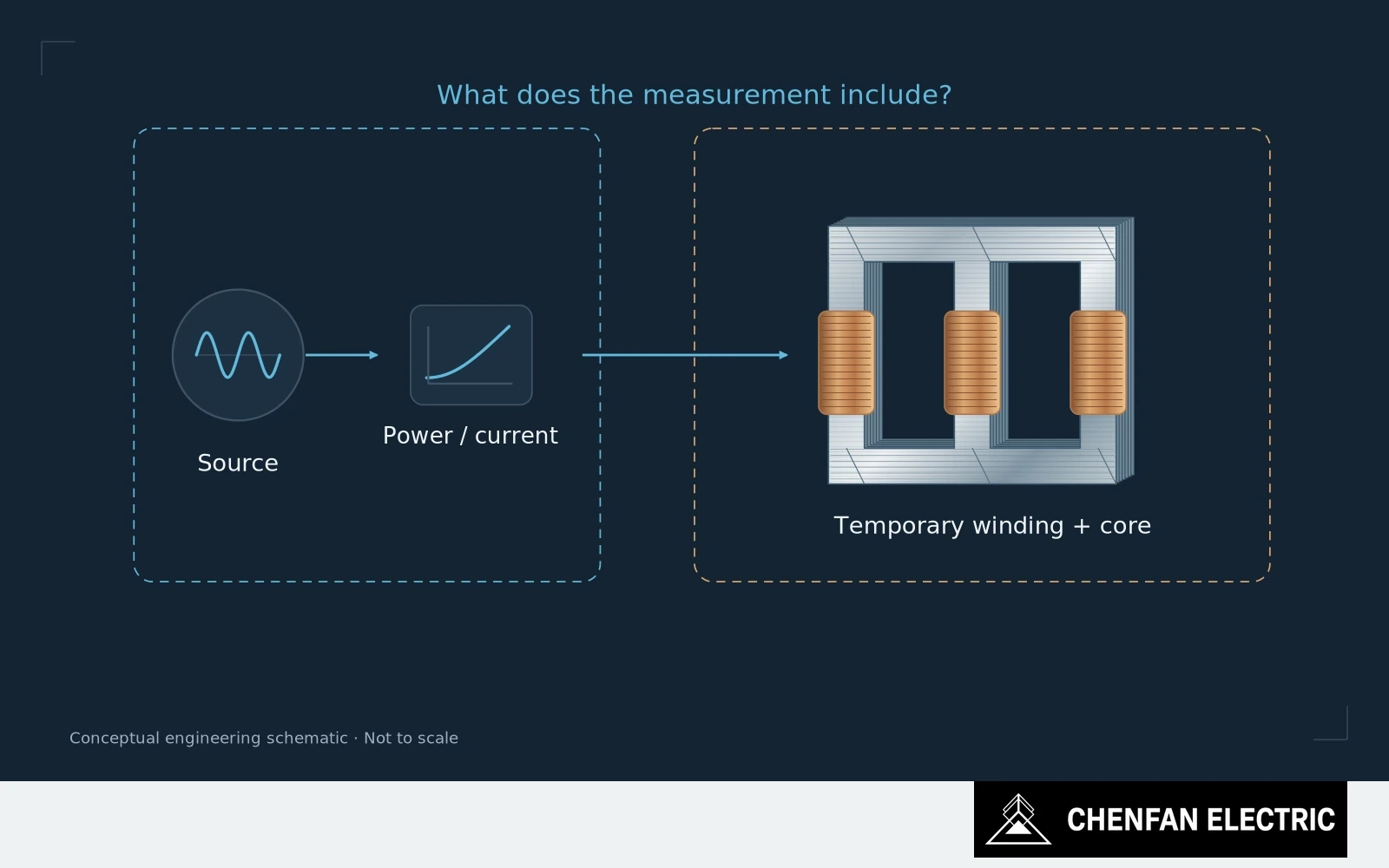
Begin with the electrical state. Confirm the actual frequency, winding arrangement, flux reference and waveform. Check instrument ranges, connections and any losses included in the measurement boundary. The distribution-transformer test method in Appendix A to Subpart K of 10 CFR Part 431 explicitly addresses waveform and instrumentation effects. It applies to covered distribution transformers, not automatically to a bare-core test. The relevant core-test procedure needs comparable clarity about its own boundary.
Then check the calculation. Was the predicted loss based on the correct iron mass and actual grade? Was a typical material value treated as a guarantee? Was a specimen conversion applied twice, or was gross area confused with effective iron area? These errors can create an apparent manufacturing penalty without a defective core.
Only after establishing a repeatable discrepancy should the investigation move to the assembly. Review recent changes in joint sequence, tool condition, alignment and clamping. Inspect for evidence of unintended conductive paths or local mechanical damage using an appropriate procedure.
Examine assembly and material evidence
Material verification remains part of the investigation, not an excluded possibility. Trace the installed packets to their coils and compare retained samples on a consistent test basis. Do not assume that matching paperwork proves the identity of every installed packet.
Use the spatial and electrical evidence together. A local thermal indication may justify inspecting a specific region. A broad shift in an excitation curve may point to a different class of change. Neither observation gives permission to skip confirmation.
Use a discriminating test before upgrading GOES
The investigation should end in a discriminating test: a controlled change predicted to alter the result if the proposed cause is correct. Replacing the steel, rebuilding the joints and changing the clamp at the same time may restore performance, but it leaves the cause unresolved.
For the supplier and buyer, this order reduces unproductive argument. The question becomes which hypothesis survived the evidence, rather than whose certificate looks more convincing.
A material upgrade is justified when the analysis shows a material or design need. It should not be the first remedy for a discrepancy that has not yet been separated from measurement and assembly effects.
Practical takeaway
A repeatable discrepancy must be established before a material upgrade is selected as the remedy.
Chenfan Electric manufactures custom transformer cores according to customer drawings. Where applicable to the specified material and core design, agreed process controls include burr height below 0.02 mm and stacking factor above 97%. Measurement methods and acceptance conditions are defined for each order.