

A sheared edge has two stories: the burr you can measure and the deformed region you cannot judge by eye.
Confusing them leaves part of the cutting process unqualified.
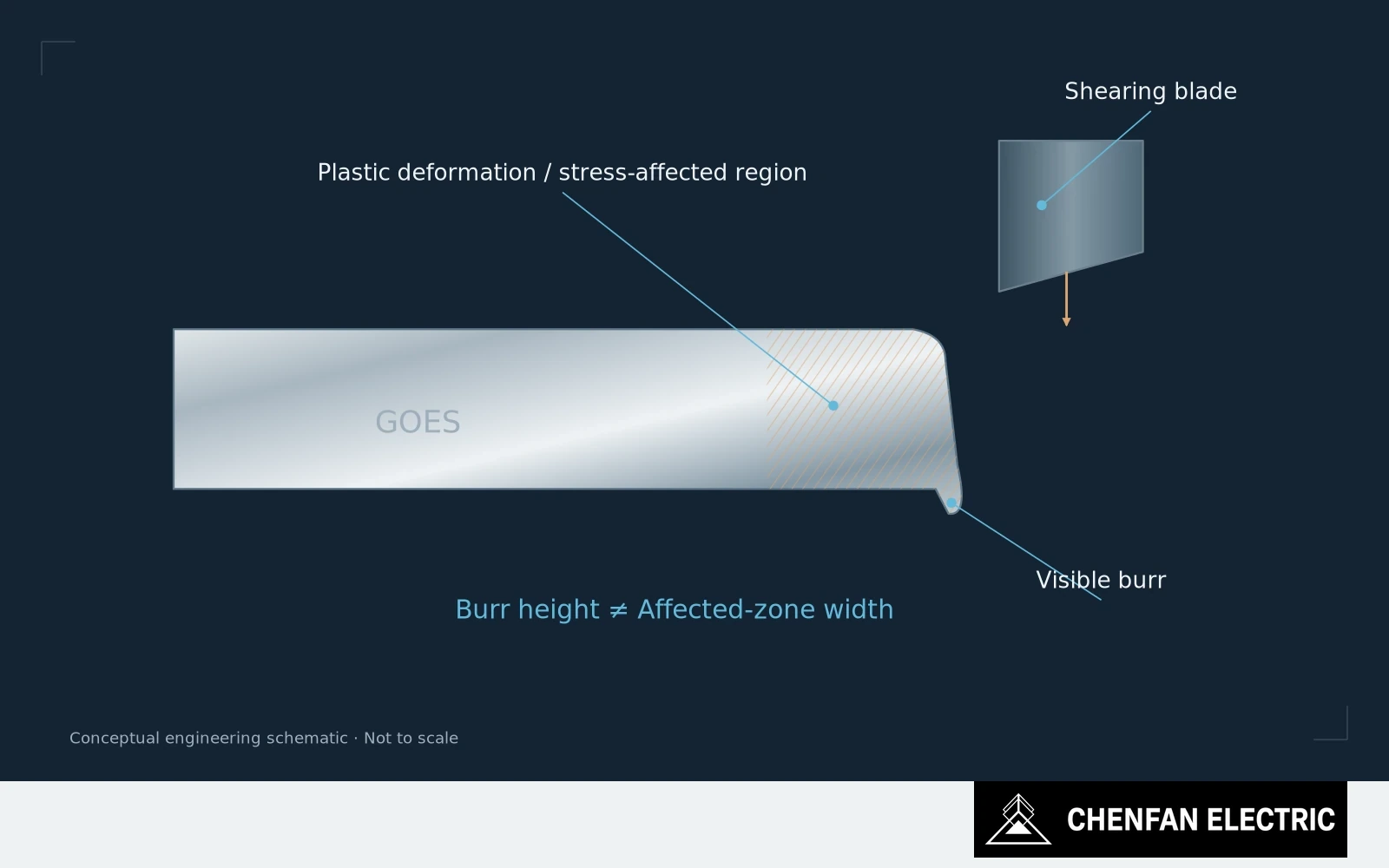
Separate visible burr from the affected edge region
Mechanical shearing changes the material near the edge through plastic deformation and residual stress. Magnetic behaviour in that region can differ from the interior. A low burr height is therefore useful evidence about one edge characteristic, not proof that cutting caused no magnetic change.
The affected fraction depends on the lamination geometry. A narrow strip has more cut-edge length relative to its area than a wide sheet. That geometric observation does not supply a universal damaged-zone width or a fixed loss penalty; both depend on the material and cutting conditions.
Tool clearance, sharpness, alignment and sheet support should be treated as a system. Selecting one setting in isolation can improve the visible edge while leaving another part of the process poorly controlled. The right qualification uses the intended grade and gauge, not only a convenient trial material.
Qualify cutting with the intended material
When reviewing research, check which steel was tested. Results from non-oriented motor laminations do not automatically quantify the effect in grain-oriented transformer sheets. Rolling direction, texture, specimen width and excitation conditions matter to the comparison.
A practical trial retains specimens before and after the proposed cutting change, uses a suitable and consistent magnetic method, and records the edge condition independently. The objective is to determine whether a process change improves the relevant product, not to reproduce a percentage from a paper under different conditions.
The joint region deserves additional care because cut edges and nonuniform flux coexist there. An edge effect measured in a straight strip cannot simply be multiplied by the entire joint mass to predict finished-core loss. The magnetic field and stress distribution are different.
Link edge control to magnetic verification
Annealing is also not a universal reset button. The thermal compatibility of the coating and domain-refinement treatment must be checked separately. A heat-resistant coating does not prove that a non-heat-resistant domain treatment will retain its benefit.
For production control, connect edge measurements to tool identity, operating condition and the containment interval since the last acceptable check. That makes an abnormal observation actionable while the affected material is still identifiable.
A cutting line is qualified when it produces the required geometry and an acceptable magnetic outcome consistently. A clean-looking edge is one part of that evidence.
Practical takeaway
Burr height and the magnetically affected edge region are different observations.
Chenfan Electric manufactures custom transformer cores according to customer drawings. Where applicable to the specified material and core design, agreed process controls include burr height below 0.02 mm and stacking factor above 97%. Measurement methods and acceptance conditions are defined for each order.