

A core passes before lifting and reads differently afterwards.
The lift is a suspect, not yet the root cause.
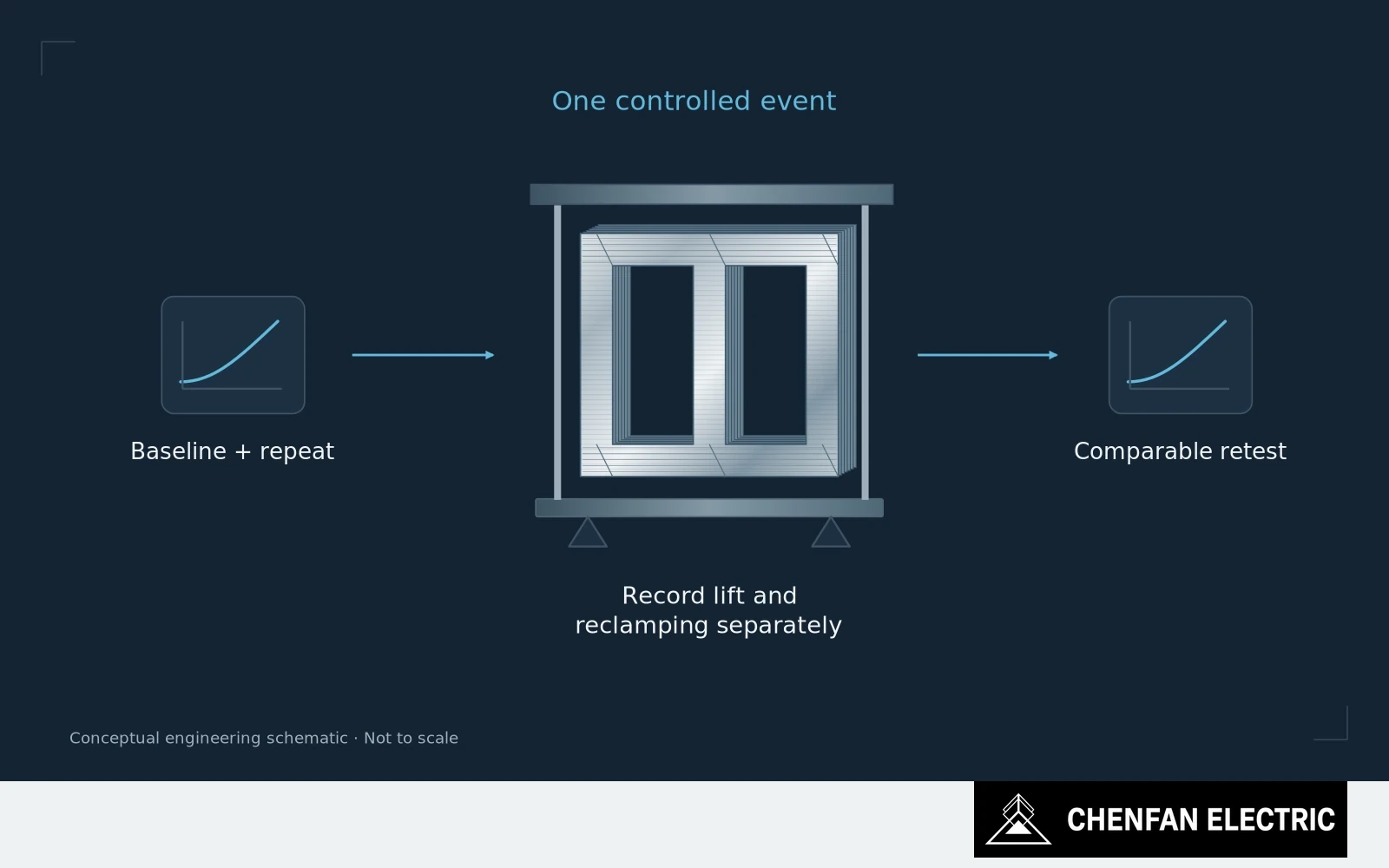
Reproduce the electrical and measurement baseline
Begin by reproducing the electrical conditions. Use the same winding connection, frequency, flux reference and measurement range. Check supply waveform and magnetic history where relevant. A changed test setup can produce a convincing before-and-after story without any physical change to the core.
Next ask whether the first measurement was repeatable. Without a baseline repeat, the difference contains both possible handling effects and ordinary measurement variation. Compare the observed shift with the uncertainty of the complete measurement, not just the accuracy printed on the wattmeter.
Only then examine what the lift changed. Moving from a stacking table to a standing support changes load paths. A transport clamp may carry forces that the test fixture did not. Local slip can alter alignment or joint fit even when the external outline remains within tolerance.
Separate lifting from reclamping
Reclamping is a separate event and should be recorded separately. If a lift and a clamp adjustment occur between two tests, the data cannot assign the change to one of them. Combine operations for production efficiency only after their influence is understood; do not combine them in the investigation record.
A staged comparison is more informative: established baseline, approved lift, inspection in the new support condition, then any specified reclamping and repeat measurement. The sequence must remain within the engineered handling plan. This is not an invitation to experiment with an unsupported core.
Look for corroborating evidence. Has a datum moved? Has a witness mark changed? Is the current change concentrated in one measured phase or accompanied by a new local thermal indication? Each observation narrows the search, but phase asymmetry or a warm region still needs interpretation in the actual core geometry.
Preserve evidence before dismantling the core
Do not immediately dismantle the assembly to “make it right”. That can remove the very evidence needed to distinguish joint displacement from stress or measurement conditions. Record the as-found state and agree the next controlled intervention.
The commercial value of this discipline is attribution. It establishes whether a handling method needs revision, a test needs correction, or the assembly itself requires repair.
A successful lift means more than arriving upright. For a qualified magnetic assembly, the relevant question is whether the approved operation preserved the intended geometry and mechanical state within the agreed acceptance basis.
Practical takeaway
A before-and-after difference does not by itself identify the lift as the cause.
Chenfan Electric manufactures custom transformer cores according to customer drawings. Where applicable to the specified material and core design, agreed process controls include burr height below 0.02 mm and stacking factor above 97%. Measurement methods and acceptance conditions are defined for each order.