

The chemistry has not changed. The magnetic response still can.
That is the uncomfortable part of applying mechanical loads to a finished GOES core.
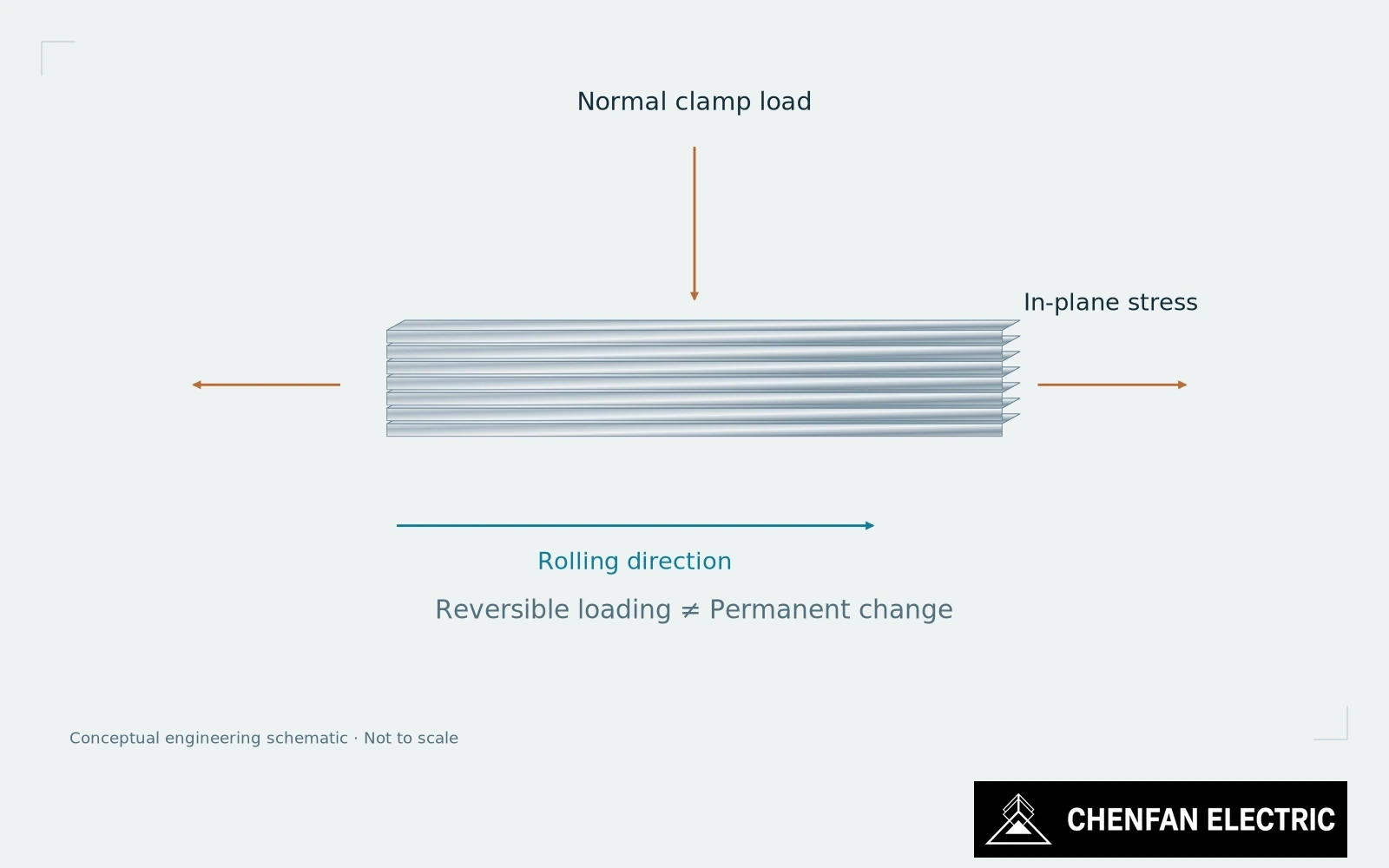
Identify the operation that changes the stress state
Ferromagnetic behaviour is coupled to stress through magnetoelastic energy. The effect depends on the stress direction, magnitude, material texture and magnetic operating point. “Stress increases loss” is therefore too crude to describe every loading condition.
The useful factory question is narrower: does this operation introduce an uncontrolled stress state relative to the one in which the core was qualified?
Stacking can restrain sheets that are not sitting freely. Clamping can create nonuniform contact pressure. A lift can change the support reactions and allow local slip. Winding installation can alter the restraint around a limb. These operations need not cause damage to change the mechanical state of the assembly.
Separate reversible loading from permanent change
Separate reversible loading from permanent change. A result that moves when a defined clamp load is applied and returns when it is removed suggests a different mechanism from a result that remains shifted after unloading. Permanent deformation, disturbed joints or damaged interfaces then require investigation. Neither observation alone proves a particular microscopic cause.
A useful study records the mechanical configuration as carefully as the electrical one. Identify the support points, clamp arrangement, tightening sequence and any change in sheet alignment. Repeating a magnetic test without those records can make a mechanical effect look like random material variation.
Do not use bolt torque as an unqualified substitute for pressure on the laminations. Fastener friction, joint stiffness and bearing geometry intervene between the wrench setting and the stress distribution in the core. A repeatable assembly procedure needs its own engineering validation.
Control clamping, thermal treatment and release state
There is also no justification for applying a generic annealing remedy to every stressed GOES product. Some domain-refined grades are not heat resistant, and the permitted thermal route must come from the material producer and the approved manufacturing process.
For large assembled cores, release should describe a mechanical state that can be preserved or reproduced at the next operation. The shipping fixture and the assembly fixture need not be identical, but their different functions must be understood.
Treat stress as a controlled process variable, not a mysterious explanation added after a disappointing test. That change makes it possible to investigate the operation rather than blaming the steel for remembering how it was handled.
Practical takeaway
Unchanged chemistry does not guarantee unchanged magnetic response under mechanical loading.
Chenfan Electric manufactures custom transformer cores according to customer drawings. Where applicable to the specified material and core design, agreed process controls include burr height below 0.02 mm and stacking factor above 97%. Measurement methods and acceptance conditions are defined for each order.