

Skip the second tour of the cutting line.
Choose a completed core at random and ask the supplier to reconstruct how it was made.
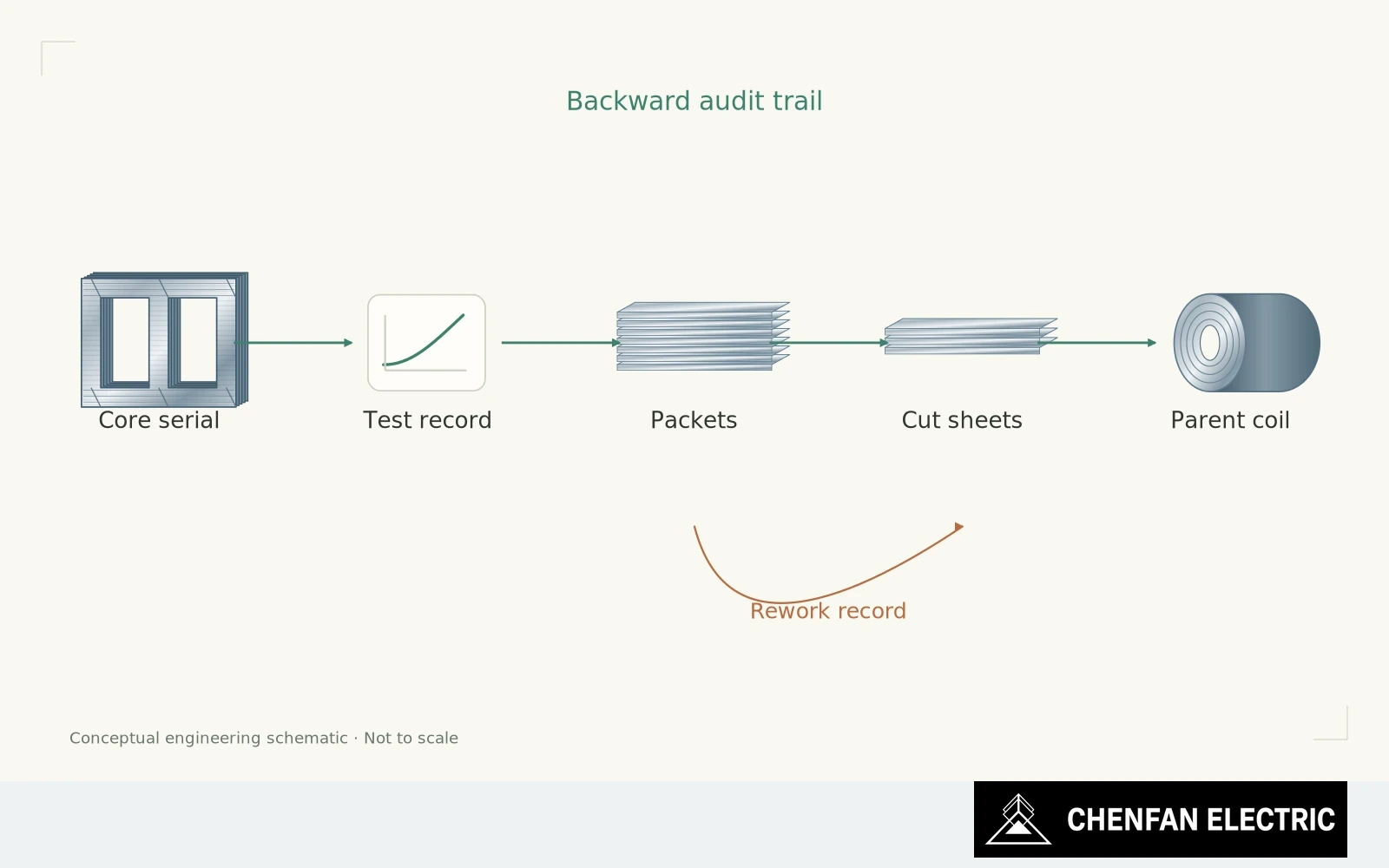
Work backwards from the test record
Start with its test result. Can the technician retrieve the original readings, excitation conditions, instrument identity and released configuration? A polished certificate is less informative than the record showing how the result was obtained and whether it was repeated.
Move back to assembly. Which drawing revision and packet sequence were used? Where were critical joint and interface dimensions checked? What happened when a measurement was outside the process limit? The answer should identify an actual disposition, not just a blank inspection form.
Then follow the packets to cutting and slitting. A coil number on the finished report is useful only if the material route connects it to the installed sheets. Look for the way partial packets, returned material and rework are identified. Those are the places where an otherwise tidy traceability system is tested.
Check tooling and measurement consistency
Tool control is another revealing stop. Ask what triggers a tool check or adjustment, how edge condition is assessed, and how the factory contains production since the last acceptable check. The particular interval should reflect its process; a universal interval copied into an audit checklist proves little.
Finally, inspect measurement repeatability. Have different operators obtained consistent dimensions on the same reference feature? Has the magnetic test been repeated without altering the core? NIST’s gauge-study framework separates repeatability, reproducibility and stability because they are different sources of uncertainty.
The aim is not to demand a statistical index for every low-volume custom dimension. It is to establish that the factory knows which variation belongs to the product and which belongs to the measurement.
Use corrective-action evidence to qualify the route
I would spend part of the audit on one resolved nonconformity. What evidence narrowed the cause? What changed? How did the supplier establish that the correction worked on later production? A supplier that can explain a contained problem may be easier to qualify than one that presents only flawless examples.
Machines establish a range of possible work. Records show whether the factory controls the work it actually accepts.
Leave the audit with an evidence-backed view of the relevant core family: traceability, process control, test capability and corrective action. An impressive inventory photograph does not answer any of those questions by itself.
Practical takeaway
One randomly selected finished core can reveal more than another equipment tour.
Chenfan Electric manufactures custom transformer cores according to customer drawings. Where applicable to the specified material and core design, agreed process controls include burr height below 0.02 mm and stacking factor above 97%. Measurement methods and acceptance conditions are defined for each order.