

Send the same incomplete core RFQ to five factories and you may receive five technically different offers that all say “compliant”.
Grade, thickness and an outline drawing establish only part of the purchase. They do not define the assembled condition in which magnetic performance will be accepted.
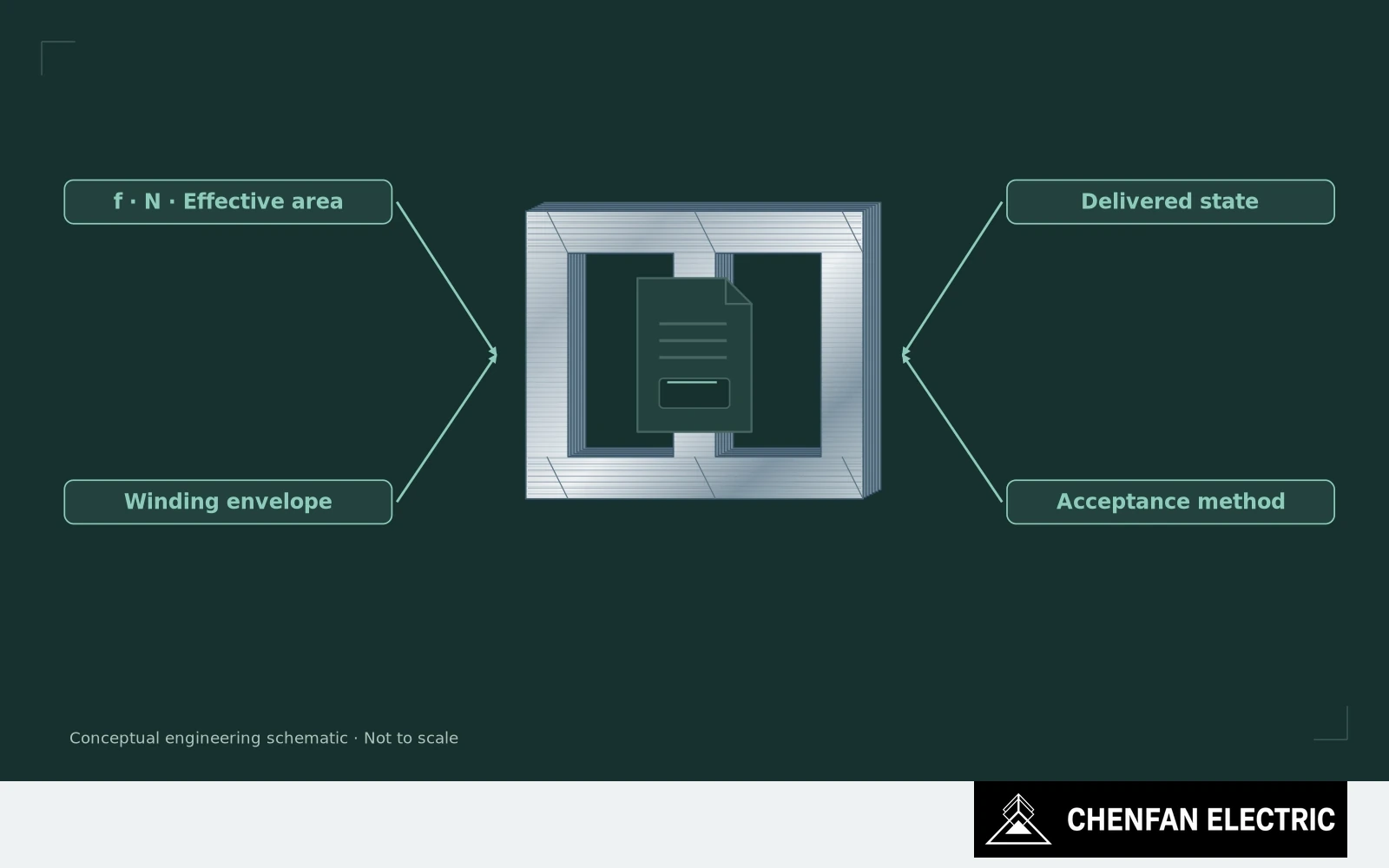
Define excitation and delivery configuration
I would resolve the excitation basis before asking for a loss guarantee. Specify frequency, the intended flux-density reference and how effective iron area is established. For a temporary test winding, agree the turns and voltage determination rather than assuming that a percentage of an unspecified voltage defines the same magnetic state.
The second boundary is mechanical. Is the core tested flat or standing, with which clamp arrangement, and before or after the agreed turning operation? Does delivery include a closed top yoke, or will it be reopened for winding insertion? The supplier cannot reasonably guarantee an undefined assembly state that another factory will create later.
Then state the acceptance quantities independently. Loss, exciting current and critical assembly dimensions answer different questions. A limit on one does not automatically protect the others. Where noise is relevant, define whether you require a core-development observation or a standardized completed-transformer sound test.
State acceptance limits and reporting scope
Do not attach a long list of standard numbers without explaining which activity each governs. Material inspection, finished-core verification and transformer FAT have different objects and methods. A standard for steel specimens is not a complete procedure for your assembled core.
The RFQ also needs a response structure. Ask the supplier to declare assumptions, exclusions, proposed deviations, test capability and the evidence included with shipment. A clear deviation is easier to evaluate than a hidden assumption inside an attractive price.
Resolve assembly interfaces before award
For custom cores, I would add a short interface sheet covering window clearance, limb centres, reference datums, removable components and responsibility for reassembly. Production should sign that sheet before purchasing freezes the order.
Finally, agree what happens near an acceptance limit: measurement uncertainty, retest conditions and the authority to release a deviation. Leaving these until a borderline result appears turns an engineering question into a negotiation under shipping pressure.
A good RFQ should let two suppliers quote the same magnetic and mechanical handover. It need not dictate every factory operation. It must make the purchased result and its verification unambiguous.
Practical takeaway
An incomplete RFQ can produce incompatible offers that all claim compliance.
Chenfan Electric manufactures custom transformer cores according to customer drawings. Where applicable to the specified material and core design, agreed process controls include burr height below 0.02 mm and stacking factor above 97%. Measurement methods and acceptance conditions are defined for each order.